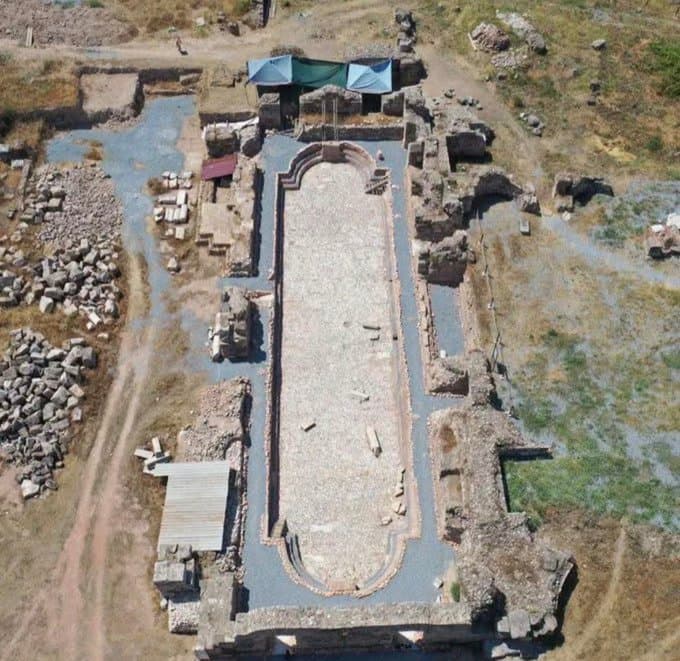
A 2,000-year-old Roman-era swimming pool has been uncovered in Aydın, offering a glimpse into how ancient Romans enjoyed leisure and bathing.
Archaeologists excavating the ancient city of Tralleis near Aydın in western Türkiye have fully uncovered a remarkably preserved Roman swimming pool dating to around the 1st or 2nd century AD.
Measuring roughly 37 meters (121 feet) long and 12 meters (39 feet) wide, the massive pool could hold around 300 people and was part of a sprawling 40,000-square-meter bath and gymnasium complex. Researchers believe it was a cold-water pool used for swimming, athletic training, instruction, and recreation.
The complex reflects how important physical fitness and public life were in Roman society. Bath and gymnasium complexes were more than places to exercise and bathe—they also served as centers for education, business, and social interaction.
The pool was supplied by an advanced water system that continuously circulated fresh water while allowing it to drain efficiently, showcasing the sophistication of Roman hydraulic engineering.
Tralleis was a prosperous city in the Roman province of Asia, known for its temples, theaters, baths, and other monumental buildings. Excavations continue to reveal new insights into daily life in one of the region’s most important ancient urban centers.
Despite being described as an “Olympic” pool in some modern reports because of its impressive size, it was not built for the ancient Olympic Games. Archaeologists believe it instead belonged to a local athletic complex where young people learned to swim and trained for regional competitions.