Archeology in the Carribean and Future Book Review

Archaeology in the Carribean, has advanced significantly over the past decades. Particularly in San Juan, Puerto Rico which produces more archaeologists than the rest of the Caribbean combined, with professionals now conducting research globally, from Great Britain and South America to Africa and the Middle East. This expertise is supported by a strong academic community and rigorous peer review, particularly in the States. Credit is due to archaeologists in American academia whose work after the Spanish-American War was foundational; they developed initial models to explain how Indigenous populations populated the Caribbean islands. While many of these early migration models have since been revised, they provided an essential starting point for the field.

Modern archaeology, based on materials recovered in San Juan, reveals a history of extensive interaction across regions. Evidence shows sustained contact between the Caribbean, Mesoamerica, and areas as far as the Andes. Finds such as jade statues from Guatemala and the remains of dogs dating to 2000 BC in San Juan point to a sophisticated seafaring culture. Such a culture would have required advanced knowledge of astronomy for navigation across open waters.

Notably, San Juan has 857 documented but unexcavated archaeological sites, all protected by state and federal laws. Archaeologists have intentionally left them undisturbed, primarily because the necessary infrastructure for proper stewardship is not yet in place. The region currently lacks a suitable museum, and artifacts require meticulous cataloging, conservation, and professional display. Establishing a museum involves long-term planning, sustained administration, and a dedicated budget, and some sites may eventually warrant becoming museums themselves. Therefore, the current strategy prioritizes preservation in place until adequate resources and facilities are secured for future study and public interpretation.

I am writing this after finishing a book so complex and revelatory that I feel compelled to share it. The book, El Secreto Mejor Escondido by San Juan-based researcher Roberto PĂ©rez Reyes, is a 600-page tour de force that has genuinely raised eyebrows. Its author, notably, is an autodidact with a bachelor’s degree in Social Sciences, lacking formal advanced degrees in archaeology, geology, history, or astronomy. This monumental work is instead the product of 25 years of independent research.

The book presents a profound study of petroglyphs across the Caribbean, centered on detailed pattern recognition of ancient symbols. PĂ©rez Reyes’s hypothesis is that these symbols are not local curiosities but universal. He systematically demonstrates striking parallels in petroglyphs from vastly separated regions—including Mesopotamia, Mesoamerica, the Andes, the Caribbean, Africa, and Europe—and proposes they are evidence of an ancient seafaring culture. For instance, he highlights strikingly similar narratives found in Druid mythology and Indigenous Caribbean myth stories.

The work has garnered notable attention, including its inclusion in The Oxford Research Encyclopedias (OREs), which suggests it has passed a significant level of academic review, though the specific criteria for inclusion remain unclear. This combination of ambitious scope, unconventional authorship, and formal recognition makes the book particularly compelling. My mind becomes a volcano of ideas when I encounter work of this scale, and I plan to write a detailed review to introduce this complex Spanish-language work to a wider audience.

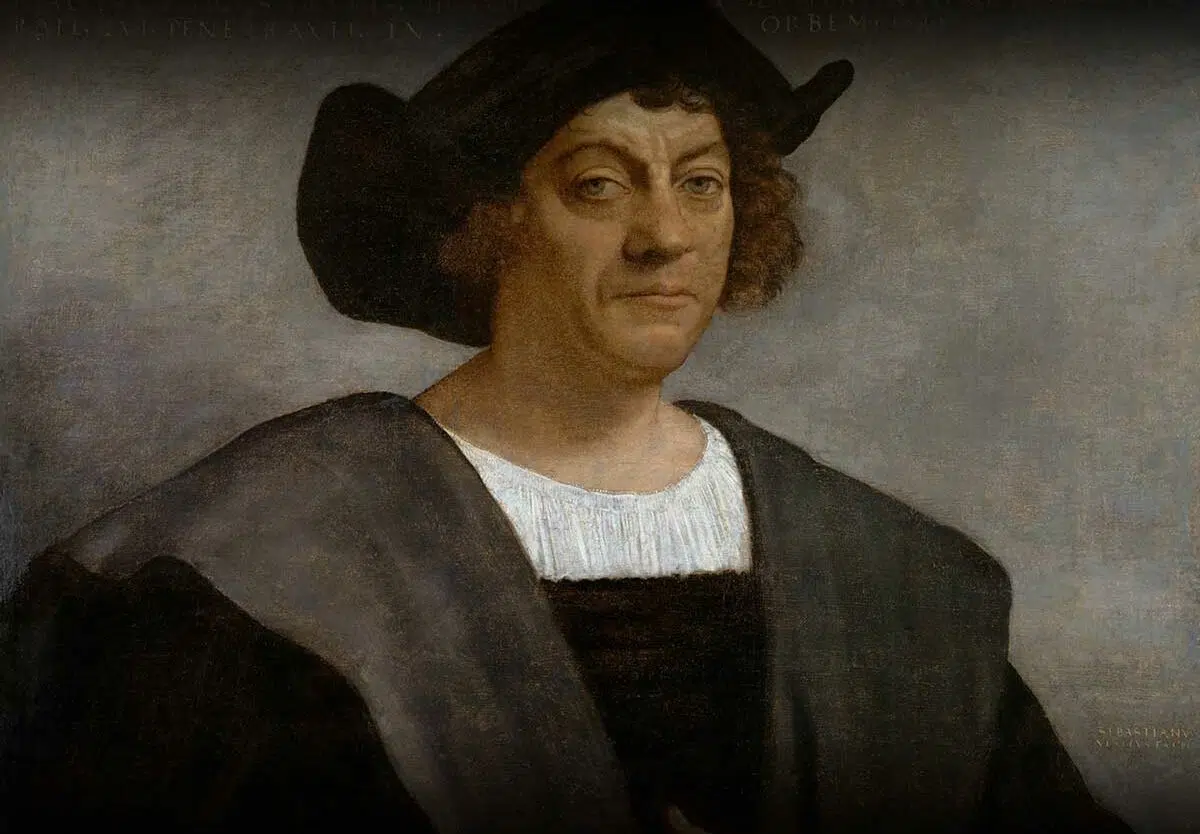
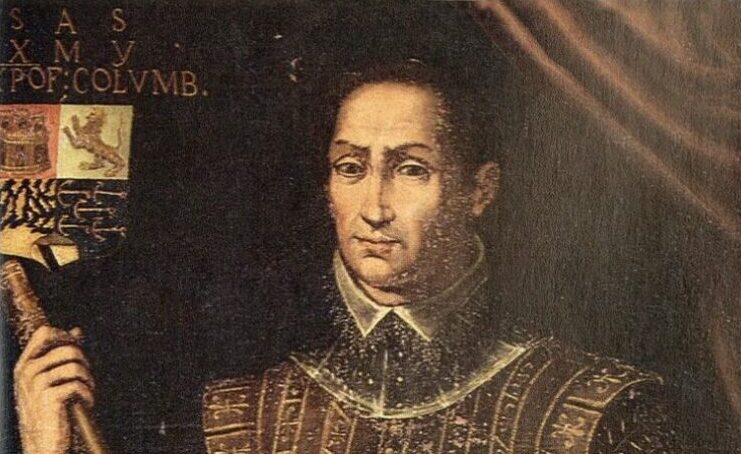
Conducting a review of this work presents a unique challenge, as it involves synthesizing a vast amount of visual material from petroglyphs with detailed historical research. PĂ©rez Reyes does not rely on symbols alone; he anchors his analysis in primary sources, including the writings of BartolomĂ© de las Casas and other Spanish chroniclers, even citing observations from Christopher Columbus, who described the Indigenous people as “smart and alert.” To build his case for a sophisticated, seafaring culture, the author compiles astonishing historical accounts that defy common preconceptions.

These chronicles describe a level of maritime and martial technology that is often overlooked. For example, they record that Caribbean Indigenous societies built large ships capable of holding 200 people, using sails made of cotton. In warfare, they employed formidable armor made from densely woven cotton, three inches thick, and protected their heads with wooden helmets. These are not the artifacts of a simple or isolated people, but of a complex society with advanced material knowledge.

My task, therefore, is to bridge the author’s three main forms of evidence: the universal patterns he identifies in ancient petroglyphs across continents, Caribbean indian language and the concrete historical records that depict a highly capable Caribbean culture. The chronicles reveal ships so advanced they featured cabins and an organized system for rotating the crews paddling them, details that underscore a complex maritime tradition. The review must navigate between this symbolic language and the tangible reality it may represent. By presenting these compelling details—from colossal ships with sophisticated logistics to intricate armor—I aim to demonstrate why PĂ©rez Reyes’s 25-year research is not only a remarkable work of autodidactic scholarship but also a provocative contribution that demands a broader academic and public conversation.

Folks, I will never ever look at Indian petroglyphs, statues, and drawings with the same eyes again. These things are deeply layered in meaning.
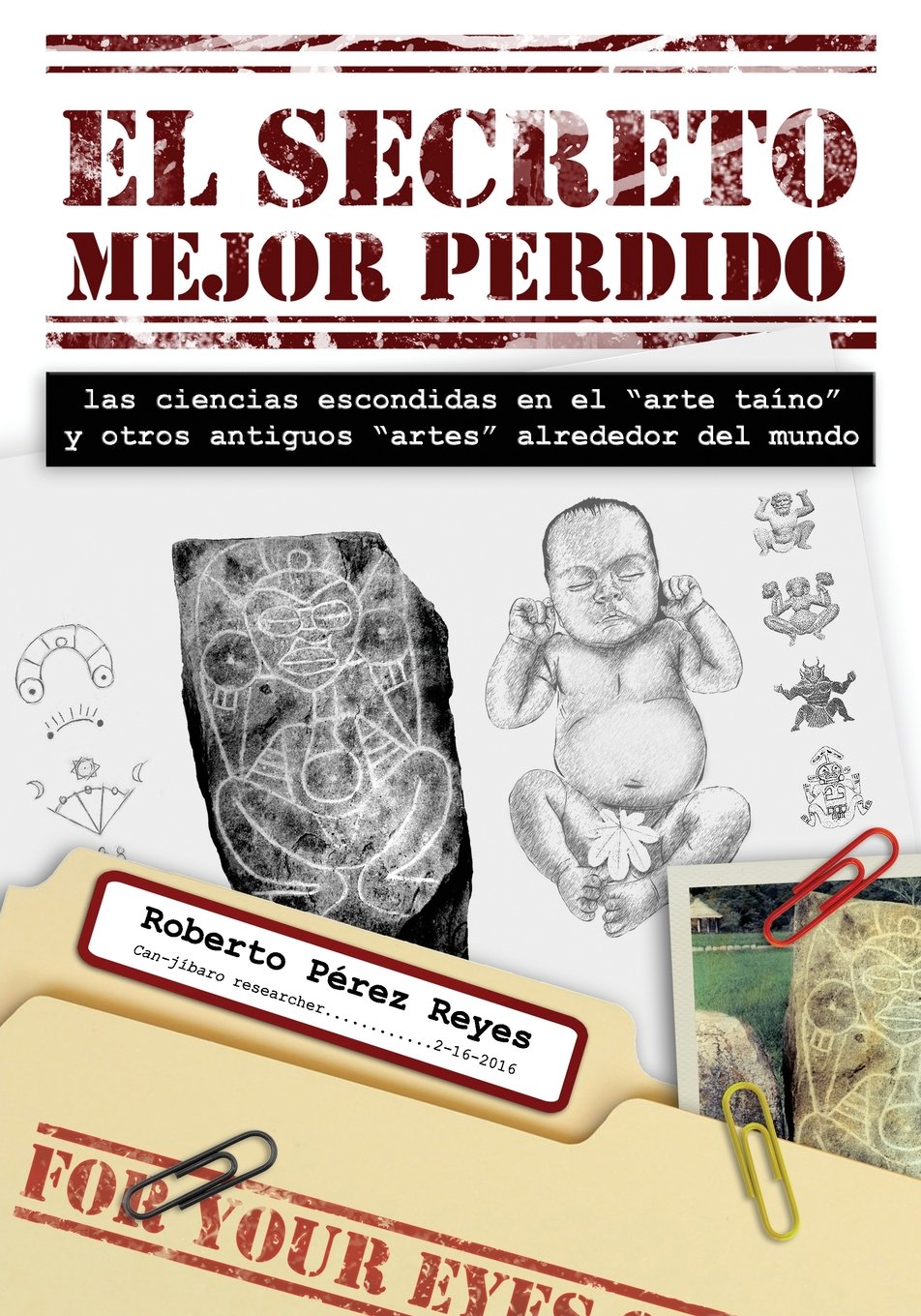
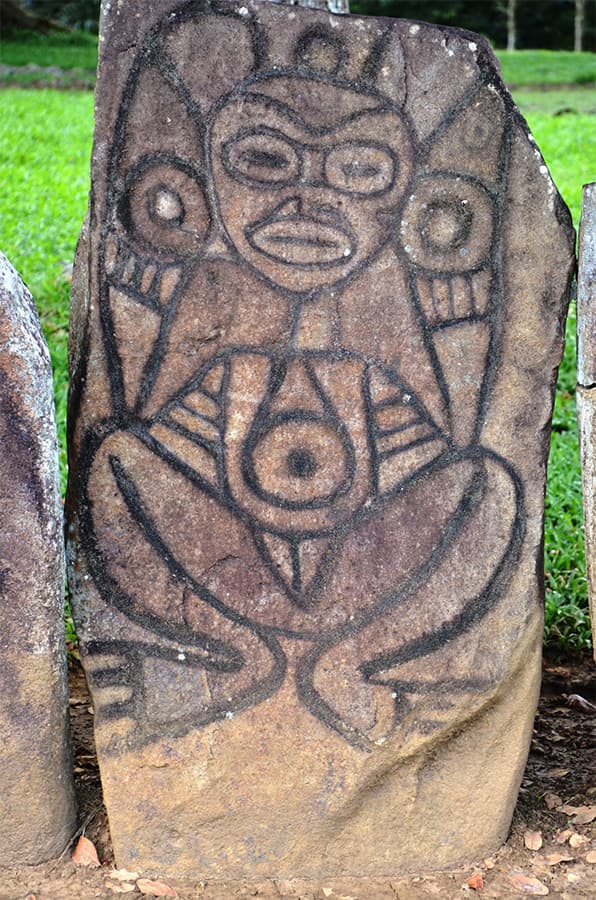
4 Likes

In historical literature, the people living in the Caribbean at the time of European expansion have been referred to as the Taíno. This notion has since been revised by modern historians and archaeology. There was never a distinct tribe or race called the Taíno; instead, the Caribbean consisted of a mosaic of diverse groups that did not even share a common language. What they shared were similar artistic traditions and cultural practices—a pattern that scholars now label “Taíno.” Movement throughout the region was constant. We must discard the outdated idea of a single migration wave of people who settled on an island and remained there. In reality, what occurred was continual movement of peoples. The sea served as their highway and their way of life. For thousands of years, these communities were in constant motion. We have millennia old archeological material from all over the continent in San Juan.

In terms of language, influences in the Caribbean came from different places, most notably from the Maya and other branches of the Arawakan language family. Additionally, numerous Indigenous words were adopted by European languages during the colonial period. The very first such word introduced to Europe from the New World was “canoe”—a term that fittingly underscores the region’s identity. It is an apt legacy for a culture defined by the sea, one whose maritime traditions had already spanned several millennia.

In his book, the author further details how the meanings of certain Indigenous words adopted by Europeans were completely transformed. He explains that in many of these source languages, a single word can carry the meaning of a whole descriptive sentence—a linguistic feature known as a holophrasis . As an illustrative parallel, consider the English word “otolaryngologist”: a single term that functions as a compressed description for “a medical and surgical specialist for conditions affecting the ears, nose, throat, head, and neck.”

A profound example of this semantic shift is the word “cannibal.” It derives from the Mayan word Caniba (Ca-ni-ba), which, according to the author, originally meant “a person with four agreements.” A person with four agreements? and with who? This is tied to a rich Mayan cosmology where the element Ca is also associated with “serpent,” a figure of immense mythological significance. Thus, in the pre-Columbian worldview, Caniba did not denote brutality, or the act of eating people, but rather a complex philosophy representing a cosmological order and a way of life with the earth. When reading the Spanish Chronicles, particularly those describing the Indigenous peoples of San Juan, they are portrayed as farmer-warriors who lived by some sort of code of conduct or cosmology. Their society was both/and, capable of both peaceful agriculture and fierce warfare. Also they didn’t have a religion, they didn’t worship a deity. The closest thing to their cosmology in religion is Buddhism. The problem is that in the past people uncovered a painting of a face and they immediately assume it was a deity.

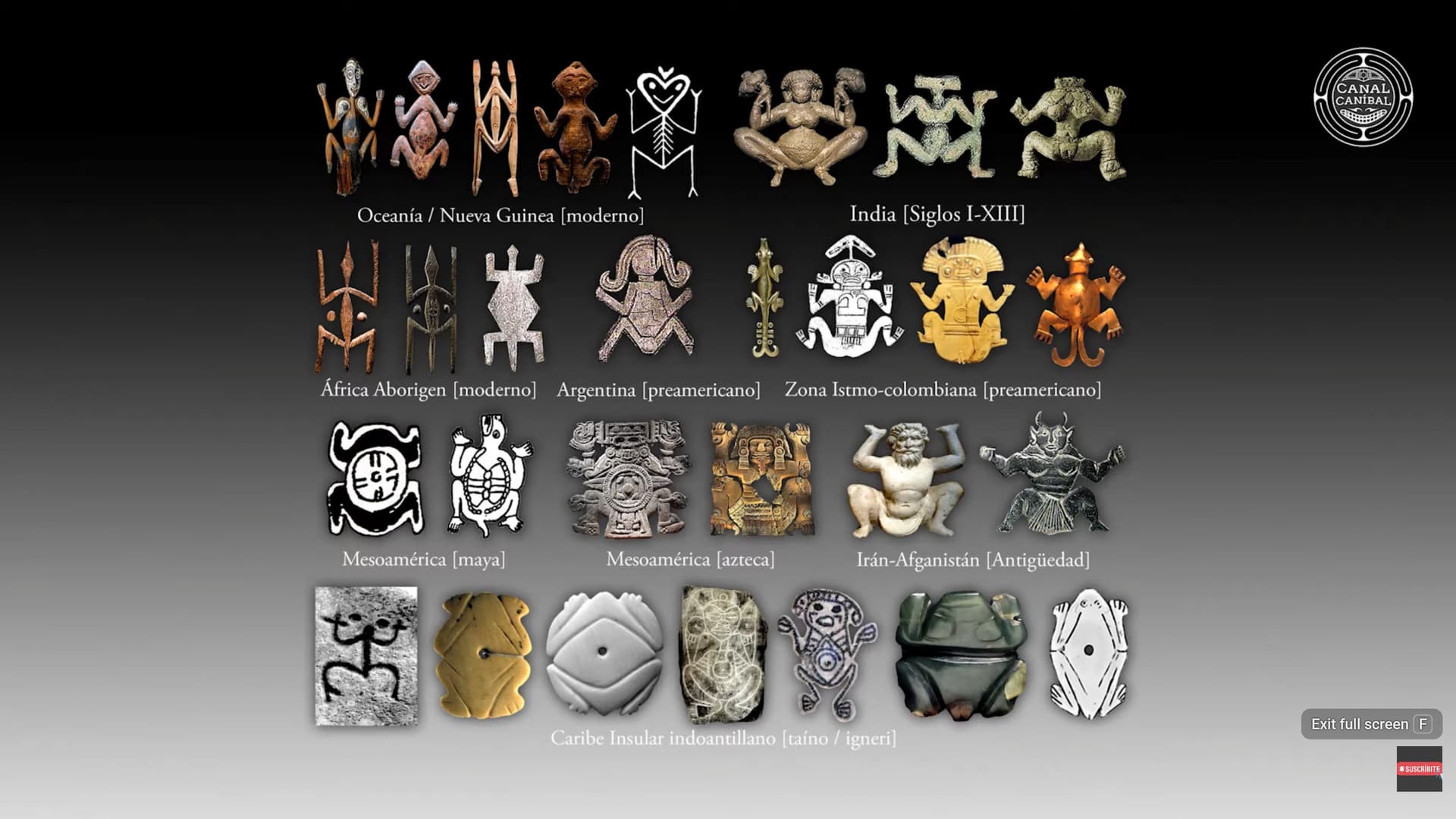
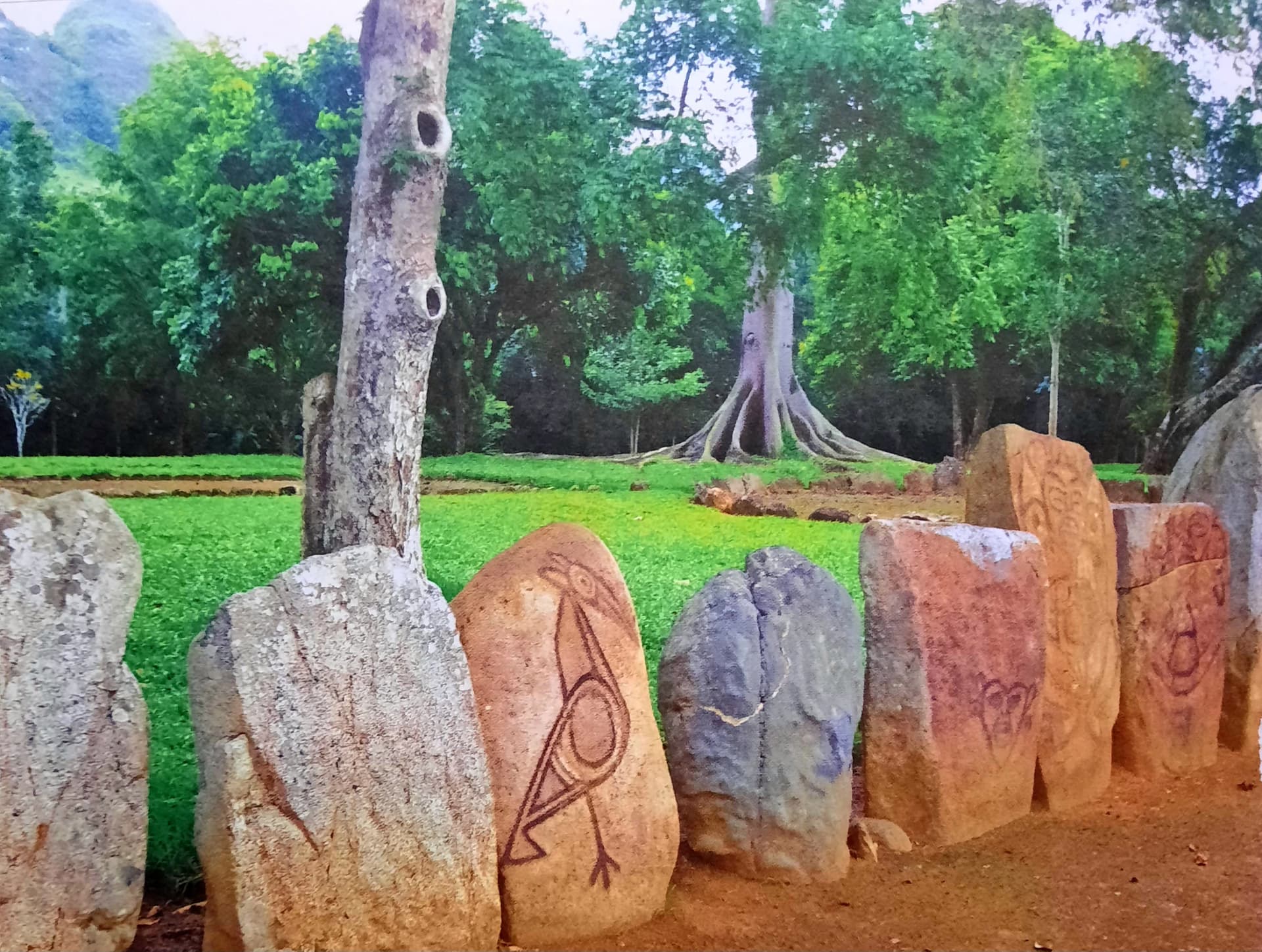
What the Indians are depicting is a language that was known to them and apparently across the globe. In the pictures shown below, the author calls it the WM hypothesis. The same form repeats itself across the globe. The arms forms a W and the legs an M. In the member area of the website, there are two dialogs one is about the Flood Myths and the other about Seafaring vs Land Bridge theory. You can plug those conversations with the topic of this book review.

Is not a posture that a normal human can make, unless you are a martial artist or contortionist. :point_up: Interesting that when one studies the Indians in San Juan you come across a little artifact called the Duho. When a person sits on the Duho you naturally assume the WM position. That is the chair where the warrior sits and becomes one with the rest of the tribe and start discussing problems as a community.
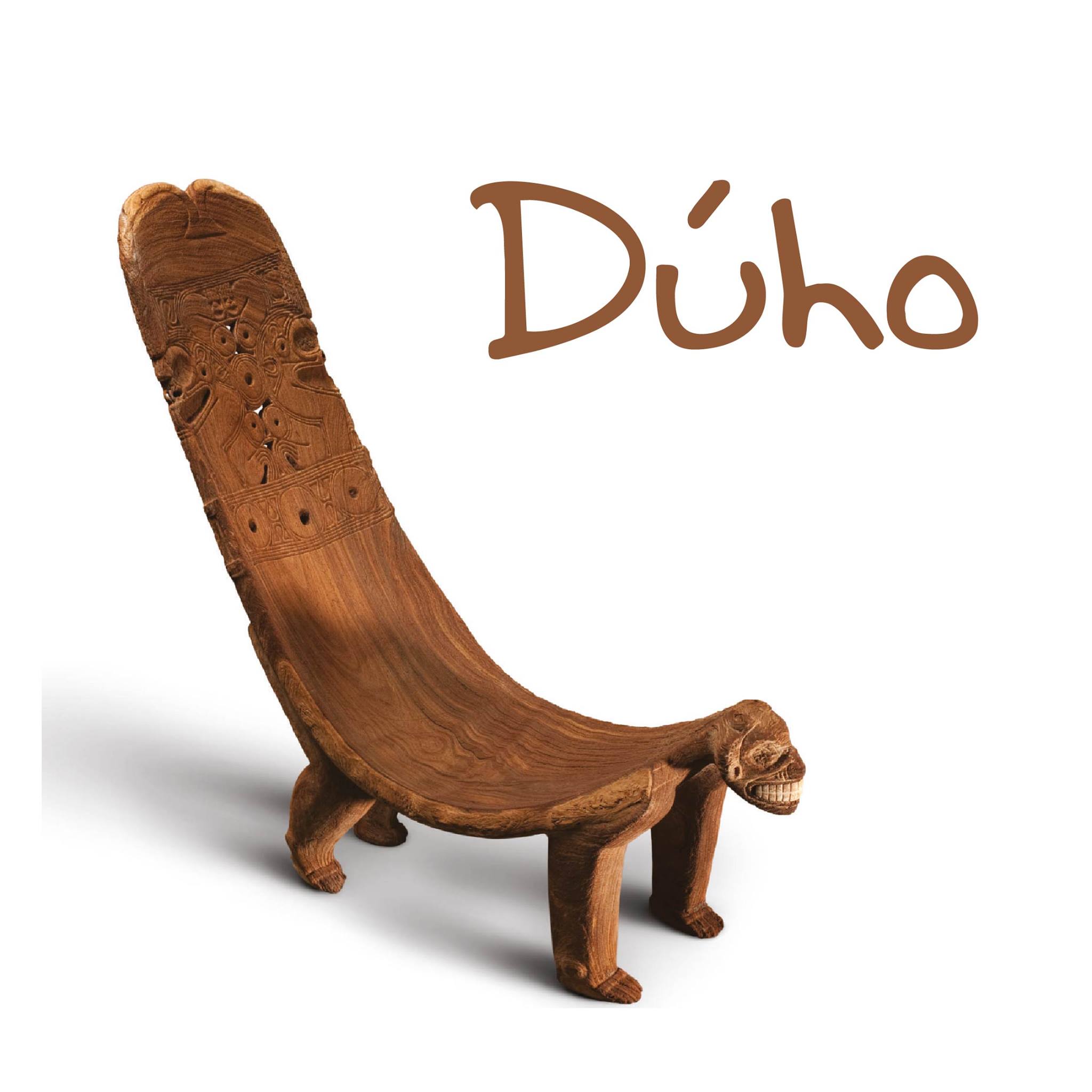
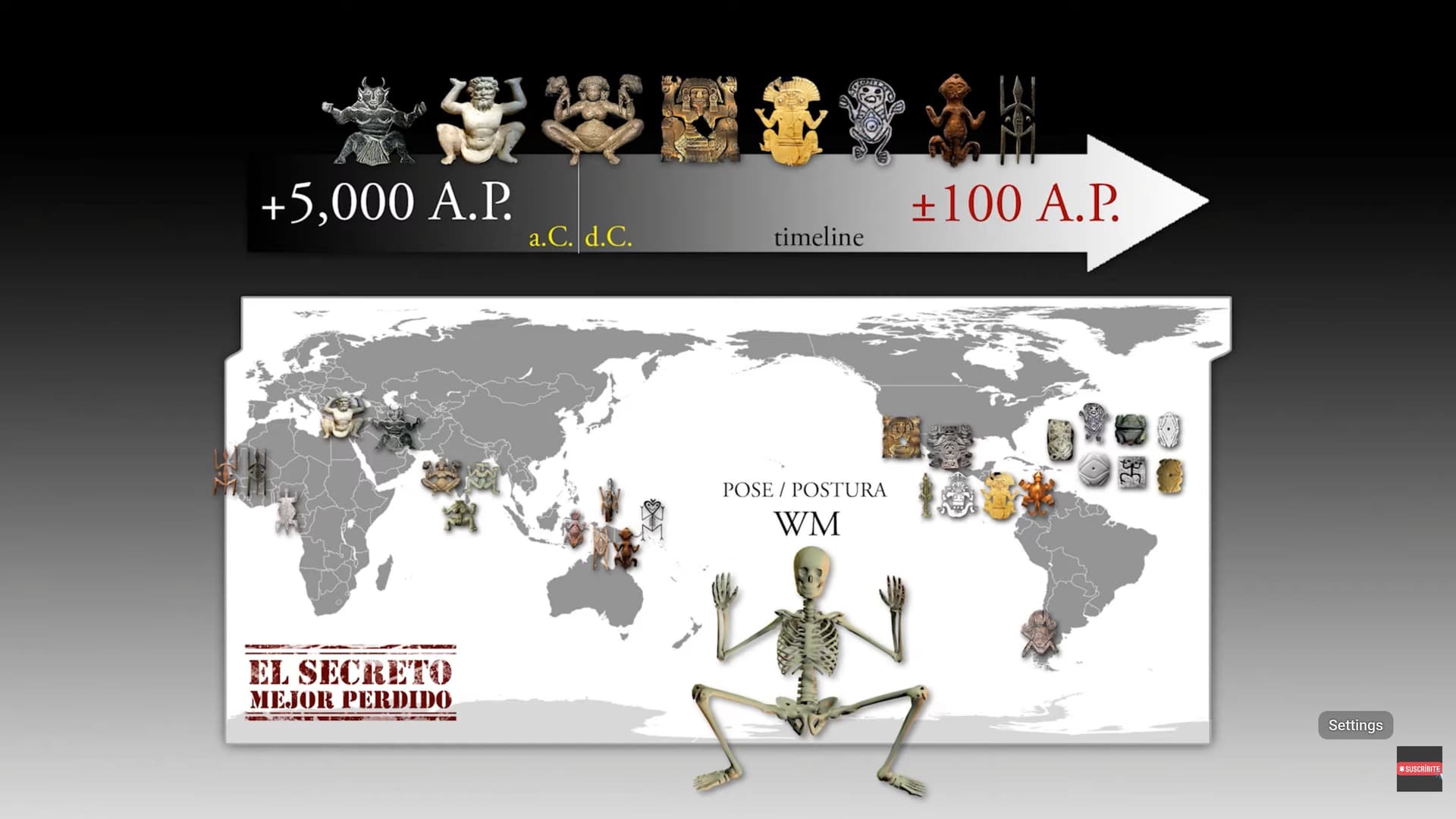
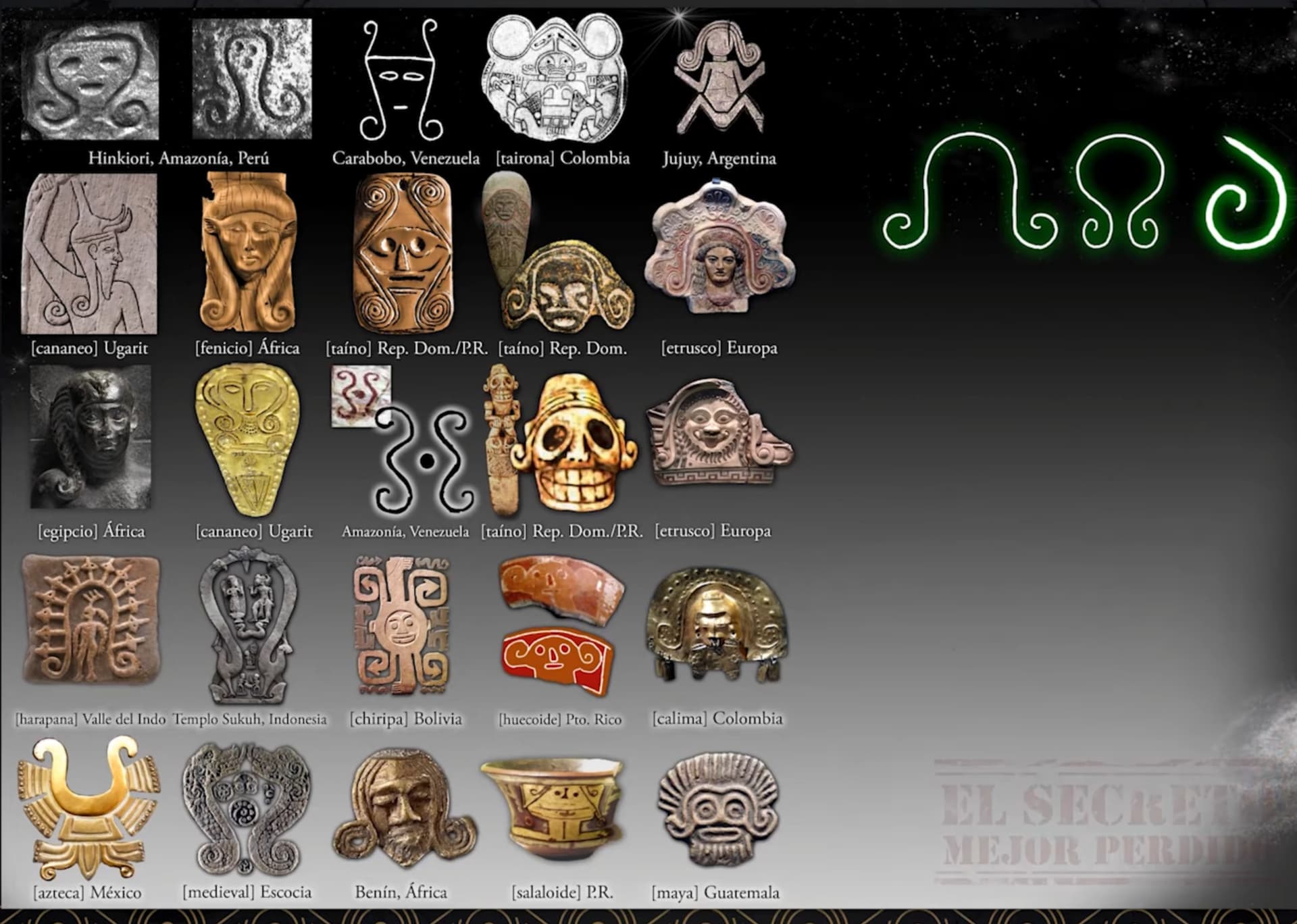
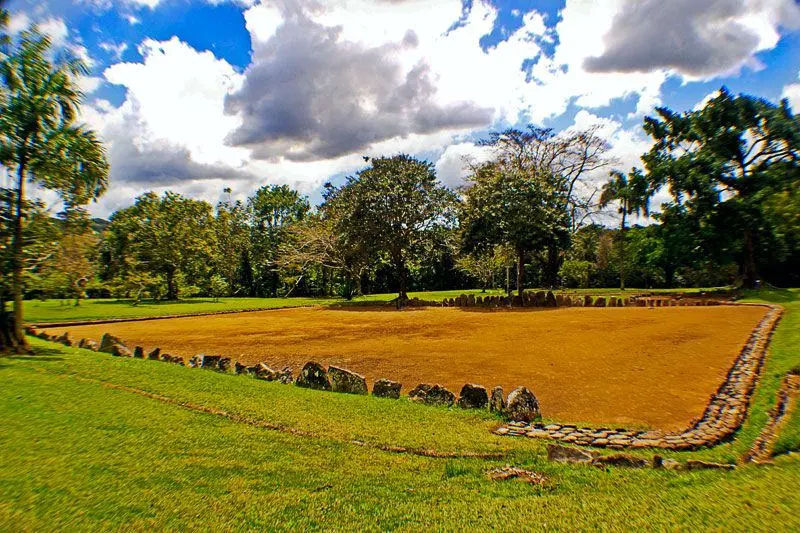
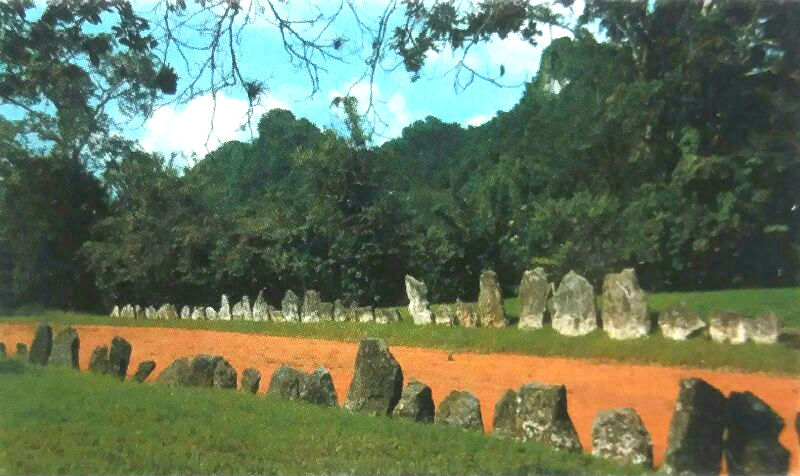
I am going to leave some pictures, so people can identify some of the patterns. Interesting that this symbolic language appears in the same belt of flood myths.

3 Likes

“And this is not because they are ignorant; on the contrary, they are of very keen intelligence, and they navigate all those seas, and it is amazing how good an account they give of everything, but they have never seen people clothed or ships like these.”

Christopher Columbus, journal entry, October 21, 1492, in The Diario of Christopher Columbus’s First Voyage to America, 1492–1493 , abstracted by BartolomĂ© de las Casas, ed. and trans. Oliver Dunn and James E. Kelley Jr. (Norman: University of Oklahoma Press, 1989), 139–141.

In other words, here we have a European mariner—steeped in the nautical sciences of his own tradition—explicitly acknowledging the sophisticated navigational competence of the Indigenous peoples of the Antilles. To navigate these seas successfully required a formidable, intimate knowledge of the natural world: the cyclical movement of stars, the patterns of winds and clouds, the subtle shifts in currents, and the behavior of the sargassum drifting upon them. Columbus, in this brief note, recognizes the existence of this complex, locally mastered science. Thus, we have Columbus stating that these people possess ‘subtle intelligence’ (sotil ingenio), meaning their knowledge is highly refined.

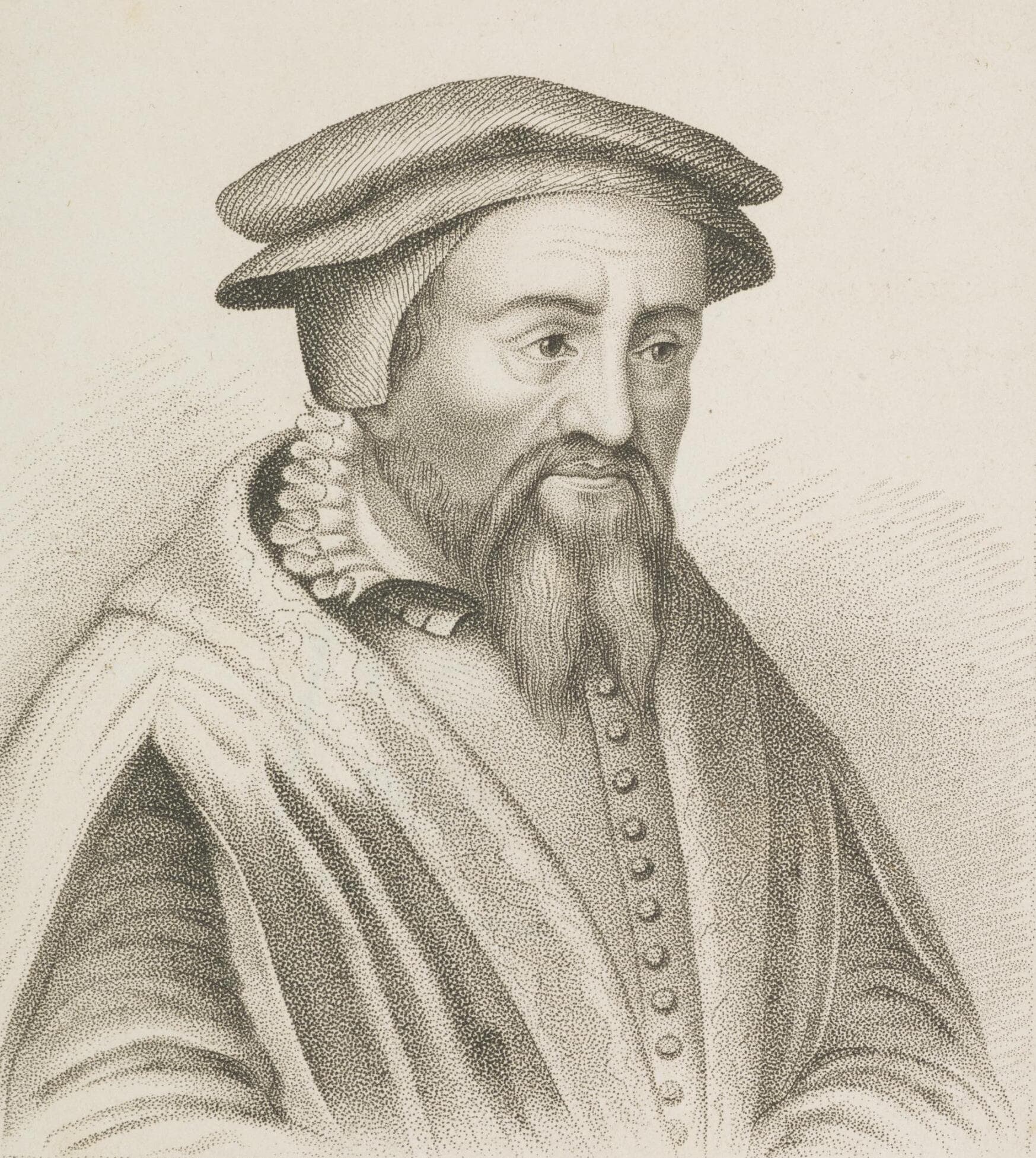
I have read all of Christopher Columbus’s journal entries from his voyages, including letters to the Pope that most history books don’t mention, as well as the chronicles from the other Spaniards on those expeditions. Also BartolomĂ© De Las Casas Five Volume History of the Indies. One thing I hope people notice is how the language used to describe the Indians changes tone over the years. The first entries are respectful, but the later ones treat them as ignorant or inferior.

This shift is deeply related to the very words ‘Taíno’ and ‘Caniba’ or ‘Cannibal,’ which did not mean what they later came to signify. The Spaniards walked into a pre-existing conflict—a civil war, or at least a major cultural and political rivalry among the Indigenous peoples of the Caribbean. ‘Taíno’ and ‘Caniba’ (Carib) represented two different philosophies of living and social organization.

1 Like

Remind me of one of may favorite books I read many moons ago:
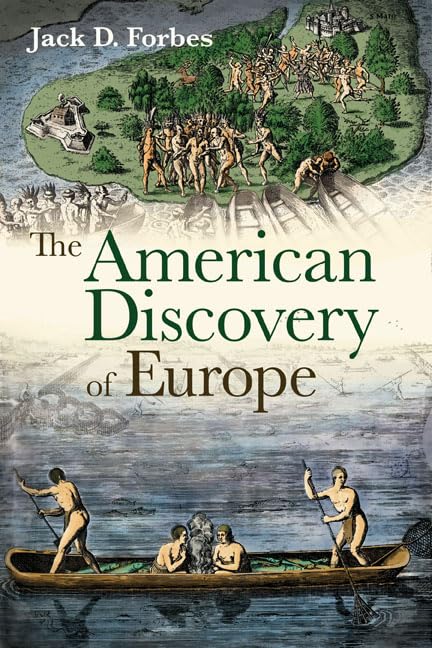
Columbus and Other Cannibals: The Wetiko Disease of Exploration, iImperialism, and Terrorism
By Jack D. Forbes, first published in 1978.
In my copy the second paragraph, page one.
" It is significant that in these ancient oral accounts the Creator arises from the primordial nothingness(obscurity) as, essentially, Wisdom. This divine Wisdom then unfolds as a mental-like process, conceving things by means of creative wisdom. Significantly, many other Native Americans record traditions of the mental nature of creation. The process of genesis is also evolutionary, a gradual unfolding of stages of creation."

His analyses of Western Hierarchy is to die for!
He uses the analogy of a “Super Chicken” pecking order.
A couple of pages worth!
LMAO!

1 Like

There is a moment during the first voyage when Columbus arrives on the coast of Cuba and the indigenous people on the shore flee, believing they were the Caniba , Caribe , or Canibales —the three terms Columbus himself used to refer to these people. The point is that when Columbus lands and the Indians run away, he manages to convince them that they are not the Canibales . The Indians then explain that when they saw the ships, they became confused, thinking they were the Caniba , Cannibales , or Caribe .

This incident reveals a crucial detail: the vessels used by the so-called Caniba , Caribe , or Cannibales must have been similar in scale to European ships. Not necessarily in design, but in size. Their size alone was enough to cause confusion from a distance.

1 Like

I mentioned it yesterday, but the information is worth repeating. Regarding propulsion technology, another key point is that BartolomĂ© de las Casas and other chroniclers mention that the vessels of the pre-Columbian Antilleans came in different sizes. The largest of them used sails made of cotton and other materials, combined with oars. In other words, they had two systems of propulsion. And they could carry up to 200 crew members—double the capacity of a typical European vessel of that historical moment.

Another thing that I discovered, is that British scholarship and archeological work have debunked the idea that the Caniba, Caribe, or Canibales ate people. There is no mention of Caniba or Caribe eating people. That is a later invention and hope to get to that later and is explained in the book.

1 Like