Summary:
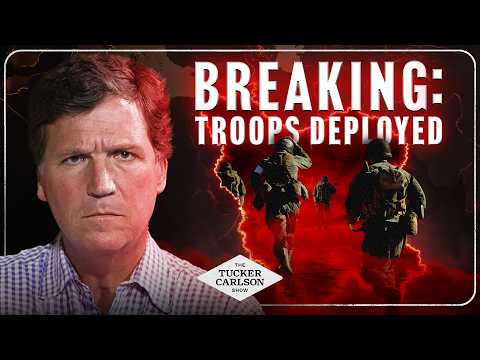
Tucker Carlson critiques the ongoing US war with Iran) followed by an interview with Jim Webb III (Iraq War Marine veteran). It is framed as a 2026 scenario under the Trump administration. Below is a topical breakdown with the core arguments and key examples from the content.
1. US National Interest: No Benefit in Continuing the War
The war provides zero identifiable gains for America— no one can rationally explain how prolonging it makes Americans safer, more prosperous, or gives their children better lives. It destroys infrastructure, kills people, and disrupts global energy markets. Everyone (including the administration) knows it should end quickly in a way that protects core US interests, avoids humiliation, and restores regional stability.
2. Path to Peace: JD Vance Negotiations
News reports indicate the Trump administration wants to declare victory and exit. The president is reportedly planning to send Vice President JD Vance (described as smart, honest, and understanding power dynamics) to negotiate a deal with Iran. This is viewed positively as a credible step to stop the death and destruction.
3. Prerequisite for Any Deal: Constraining Israel
The US cannot achieve its goals without reining in its “full partner,” Israel. Nations have different interests in a war that could go global. Israel is a much smaller country whose military the US largely funds, so it should be straightforward to demand alignment with American priorities. So far, this has not happened, allowing Israel to pursue its own agenda at US expense.
4. Two Disastrous Early Decisions That Made the War Worse
Killing the Ayatollah in the opening moments turned a limited operation (e.g., nuclear/missile constraints) into a broader war against a nation or religion, eliminating any chance of quick negotiated settlement.
5. Entering the conflict “joined at the hip” with Israel was never going to work because the two countries have fundamentally different goals. These choices were not good for the United States, and the public has a right to know how/why they were made.
6. Israel’s Independent Agenda and Humiliation of the US
Israel openly pursues territorial expansion (e.g., moving borders outward in Lebanon, taking land) using US money, weapons, and lives. Netanyahu’s statements after the US announced de-escalation (pulling back from striking Iranian civilian infrastructure) emphasized Israel’s “vital interests” over American ones. A former Israeli leader (Ephraim Bere) noted that humiliation is a feature of how Israel deals with other nations—it is not enough to win; the other side must be crushed. This dynamic humiliates the US publicly and erodes American confidence in its own government. Examples include Mossad (not CIA) intelligence driving the Ayatollah killing and regime-change assumptions.
7. Escalation Risks: Boots on the Ground and Regime Change
Despite early denials, preparations are underway for ground operations (thousands of US troops moving, 82nd Airborne elements deployed). Regime change in Iran is now openly discussed and would require a long-term US troop commitment. Hawks like retired Gen. Keith Kellogg (criticized for his Ukraine role) downplay risks and push for seizing islands/Strait of Hormuz “like the Romans.” No strategic explanation has been given to troops or the public. The military is not enthusiastic, and the war is not going well (US aircraft losses).
8. Domestic Costs and Neglect of America
The war costs ~$1 billion per day while US infrastructure crumbles (airports, bridges, air traffic control, refineries exploding). Native-born American unemployment is rising. Leaders are distracted by empire-building abroad and ignore the homeland. War accelerates societal changes, often for the worse. Democracy feels broken because decisions are made without public debate or explanation.8. Global Blowback: Damage to Europe and Dangerous Precedents
Europe is the biggest victim after the Gulf states—its energy is destroyed (by both sides), leading to depression and another migrant crisis. Israeli leaders (e.g., Naftali Bennett) openly express hostility toward Europe while demanding gratitude. The war sets terrible precedents: assassinating heads of state, targeting civilian infrastructure (US did Nord Stream; Israel does bridges in Lebanon), and openly seeking regime change for resources. These could eventually be used against the resource-rich, lightly populated US. Blowback includes terrorism and infrastructure attacks at home.
9. Moral Authority, War Crimes, and Political Consequences
Tens of thousands of non-combatants (including Christians in Lebanon) have been killed with US weapons. Evidence of war crimes exists (some real, some propaganda). Evangelical leaders who stay silent lose all credibility. The truth will come out, shifting US politics (especially the Republican Party) and eroding America’s global moral authority—the real source of its power. Young voters (key to Trump’s win) largely oppose the war.
10. Rise of Authoritarianism at Home During Wartime
Wars expand government power. Examples: a Michigan sheriff arresting someone for a meme mocking him (First Amendment violation); threats of FBI investigations; neocon talk of jailing war opponents if there is domestic terror blowback. A draft would be tyranny—forcing people to die for a war they oppose and do not understand.
11. Jim Webb Interview: Veteran Perspective on Ground Troops, Honor, and Exit Strategy
Webb (Iraq veteran from a multi-generation military family) says:
-
No clear objectives have been explained to troops or the public—this is not fighting for America but for Israel.
-
The military is unprepared (drones, counter-insurgency hangover from GWOT).
-
Ground operations in Iran (e.g., Strait of Hormuz, Karbala Island) are folly—war-gamed in 2002 (Millennium Challenge) and ended badly even when rigged.
-
Killing the Ayatollah was a catastrophic taboo that created a martyr and eliminated off-ramps.
-
US troops avoided civilian casualties far more than claimed; comparisons to IDF are slanderous.
-
Honor requires fighting only for US interests, not as a “mercenary force.” Webb would not let his own kids join under these conditions.
-
Exit strategy: Constrain Israel, use diplomacy, offer Iran removal of US regional footprint in exchange for de-escalation. Otherwise, it becomes a Vietnam-style quagmire that weakens America globally and could lead to wider conflict.