
GRAMMAR, SYNTAX, AND THE LANGUAGE OF (SOME) BIRDS

These tests were conducted with an owner that was 20 miles away. The doggie alerted and went to his post the moment the decision was made to START the journey home…This implies a psychic connection. Beyond the five senses.

Perhaps I can locate the test…

Edit:

Rupert Sheldrake…

Ah doc beat me to it… AND MarkSean had already posted it… Sorry Charlie!

Another one…German with Engilish subs:
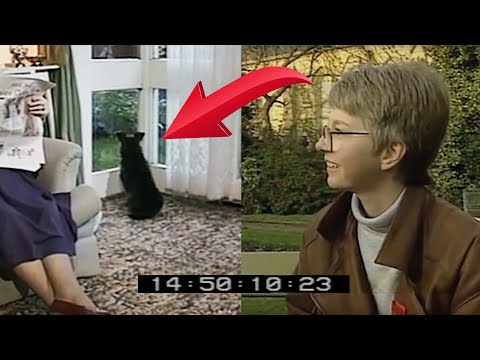
Here are some of the anecdotal comments below this video (many more of same there)

This exact thing happened every night with my dog on my return home from work. My mother noticed that my dog would go sit by the front door, whimper slightly and not move from that spot until I walked in about 10 minutes later. I did not catch the same train home each evening. My mother also noticed that during the time that my dog was ‘stationed’ at the door, he would not look at my mother, or acknowledge her in any way, even though my mother and the dog had be best buddies all during the day up to the moment he went and sat by the door. He was a special little dog - I really loved him !

My grandfather who was born in 1932 told me about one of the dogs his family had when he was a child. My great grandfather had to walk nearly a mile to catch a ride to work and each morning their little dog would walk with him. The dog also would be there when my great grandfather would return home. My grandfather stated to this day he still has no idea how the dog knew when to leave to walk to where my great grandfather would arrive in order to meet him. It didn’t matter if my great grandfather was running early or late, their dog would always know when to go and sit for him to get home. I cannot wait to show this to my grandpa. As of now he says “It is was the damnedest thing, I could never figure how she knew when to go meet him!” 😊

36
These are fantastic experiments! This reminds me of a time about 15 years ago when a neighbor asked me to watch their cat for a couple of days while they moved to a new house about 5 minutes away. The cat had never been at our house and was very displeased about the arrangement. He hid in the basement for the two days, coming out randomly to eat and use the litter box - mostly at night when we were asleep. I wasn’t certain of the exact time they were going to come by and pick up their cat, only that the cat would be with us for about two days while they completed their move. Without warning on the afternoon of the second day, the cat suddenly appeared upstairs and sat at the living room window. Soon after, our neighbor arrived to pick up their cat. The cat had emerged at about the exact time his owner would have left their new house to make the 5 minute drive to come pick him up. I have always been baffled and astounded by that

I had a dog called Oso that always knew when my father was coming back from work, around 10 or 15 minutes before. He also knew when I was coming back from any place, at any time, no matter what mean of transportation. He would go to the front and start barking around 15 minutes after my arrival. God how I miss that doggy

4 Likes

Check dr. Rupert Sheldrake as I think he has either proposed or actually conducted such tests. I do know he mentions this phenomenon in one of his books, but I forget which book.

4 Likes

… Here you go! Enjoy!

from Mark Sean above on 2 Feb 26 …

Studied psychology majoring in consciousness and spirituality and yes there was there is a huge relationship animals have with both. One of my professors was biologist Rupert Sheldrake. Many studies in consciousness of animals, whose connection with their human family enhances both their consciousness and their perception, at long range I might add. Good examples here of his work and why I think animals are just an expression of what we are all connected with/to. Animal Powers

6 Likes

A neighbor of mind adopted one of the community cats I was caring for. She was a shy thing. Lived in a tree instead of down on the ground with the other cats because they didn’t like her. She didn’t have anything to call her own. My neighbor asked me, after having her for a few weeks, if she could stay in my apartment when they went on a short vacation. Sure. She had recovered from Trap Neuter Release in my house and was used to it and she had a big room to herself. My neighbor brought the cat over and “all” her things. She now had a nice box with blankets, toys, everything she could want. And she knew it. If I touched anything in the box, she checked to make sure I didn’t move it. It was like, “I’ve got stuff now and it’s mine.” When my neighbor returned and came to get her, the cat was waiting at the window. She watched my neighbor as she carried all kitty’s “stuff” back home. She knew which house was hers and she knew someone was taking her back “home” and she wasn’t living in a tree anymore.
I had a cat once that didn’t understand time change. It was okay when it changed in the spring, but one fall day I came home from work an hour later and boy did I catch heck for that one.
I was cat sitting for a friend once and one of her kitties would wait at the window when it was time in the mornings for me to appear. He’d see me come from the parking lot across the street and I would see him let out a big yell from the window to alert the others the “foods here.”
It’s not just dogs and cats. We had a rooster once who knew when mom took out the farm car to go to town. He would wait at the car door for an invite into the back seat that she allowed. It was an old car. He truly enjoyed those into town trips. But he’s the only chicken that I knew that actually had some level of personality.

5 Likes

Robert, your idea resonates with my own ponderings as well…

And then, you mention the idea of genetic engineering, which I’ve been exploring too (especially ideas in Sitchin’s books).

Now, blending those ideas – the idea that ALL beings have access to different dimensions (and thus “intelligences”), with this idea that some may have been “genetically engineered” (both in modern and in ancient history) – brings us to some very deep questions about God versus “god”, and creatures designed by God versus those tinkered with by “gods” in their laboratories.

And — Does one treat a biological being that has been genetically engineered by a “god” as a child of God? (In my mind: yes. And, to qualify that with: we view them with compassion as one would regard with compassion a child or woman or animal who has been raped or abused; as the engineering, by man in a fallen state, of beings, to tinker with their genetics, is a violation, at least in my own mind, of God’s will. After all, we also have the test tube babies of the 1970’s…, none of which asked to be born in that way – just like all the animals in labs have not asked for their gruesome outcomes either. And, who knows, also, about the so-called “crown” of creation… and the genetic tinkering done in ancient times by a “fallen” man… )

I recently finished Father Terry Martin’s book “Animals in Heaven?”, and I have to say, this is one of the most inspiring pro-life books I’ve read in a good while. In his chapter on “Why Did Saint Francis Preach to the Birds?”, he quotes a passage from a church document which expounds upon the idea of “vocation” which is “the providential thought of the Creator for each creature… Vocation is the divine invitation to self-realisation according to this image and is unique-singular-unrepeatable precisely because this image is inexhaustible… Every creature expresses and is called to express a particular aspect of the thought of God.” (p. 106)

Father Terry wrote that the way to become close to God is to perceive a ray of God emanating from each living creature, and that when one reveres all creatures collectively, one then enters into a realm where one begins to perceive the immense grandeur of God.

He writes (p. 106):

" St. Francis models this vocation perfectly, of course, but evidently sees the wider scope of all creatures having been created by God who has a “dream in his heart” for each; a remarkable thought and one which encourages us, with St. Frances, to see the reality of God in every living being.
"For St. Francis, animals are not merely incidental, or happen to exist by accident but, rather, are meant to be here, have a right to be here, and should be treated accordingly. He baulked at all forms of cruelty or unkindness to animals and instead saw them as tender brothers and sisters deserving of our love.
"It’s also important to recognise that the love which Francis had for animals is a natural and organic extension of the love which he had for God: his desire to love and to care for God’s creatures, is an instinctive result of his love for the God who created him and them. St. Francis saw the presence and image of God imprinted on all things and used that inner awareness as a means of drawing closer to God.

I believe that such ideas can be antidotal to the commodified transhumanist and anti-life world that is unfolding.

3 Likes

Love your analyses!

Take genetic engineering…
An advanced form would deal with the higher dimension’s aspect.
Perhaps, even engineering plasmas in thought processes.
Or, controlling, such processes.

In facr; could “they” engineer OUT certain thoughts?
Making you incapble of thinking in certain ways… ?
Counter to their objectives?

When you bring “GOD” into a discussion; then ALL bets are off-the-table.
No one “knows” GOD.
You can imagine, but there is no ABSOLUTE answer.
The fathers of Christianity; are our best answers to…
What is essentially unknown.
Dr. Farrell is, IMO; the best at dealing with those types of questions.

Yes, the living animals are an expession of GOD, in many ways.
Absolurly a gift, beyond any measure.
One is truly blessed, in having loving relationships with “animals”

Thank GOD!

5 Likes

Yes, I think you make good point there. And not only with genetic engineering, but also with social engineering. (And what about all that mysterious DNA that we’ve heard referred to as “junk DNA” in the past, that interest modern scholars…)

Unlike free-living wild animals, who all seem to know what to eat (if they are left alone in their natural habitats), instinctively, and how to find shelter, instinctively, and to procreate naturally, and to heal from wounds naturally – and use all of their senses and intelligences to do those basic things, many humans are somehow bound to “narratives” which guide our “thoughts” in these things.

Many people seem to be completely divorced from our God-given senses – the ones that help us process and “make sense” of our external environments, as well as our “internal senses” that inform our intuitive abilities (i.e., so that we can recognize deceptions). People don’t seem to be able to listen, not like the animals in the wild do. Or, they can’t seem to smell when something is off in the environment (i.e., pollutants that can be harmful). Or taste when something is “off”. These are basic instincts that we seem to have lost (unless we work hard to recultivate them). And the more these senses are turned “off” through the genetic and social engineering projects, the more we rely on artificial environments.

Time and again, I have read Indigenous stories about how various tribes used to observe wild animals and learn from them, and I have recently been wondering whether – suppose some of the scholarly ideas about ancient advanced civilizations are true – and suppose something happened to disrupt those civilizations – people who were accustomed to giving over thinking to technologies would naturally have been lost without natural survival instincts – and relied upon animals as Teachers.

I love observing animals, in the wild – even a snail crawling about, at ever so slow (to me) but purposeful pace, in the woods. Each one, no matter how small, has something to teach about God.

3 Likes

Dr. Farrell’s blog today; speaks to what you’ve written.
Very much enjoyed your reading your writing, and analyses.
Oh, by the way; still have that book to read:
An Unnatural Order: The Roots of Our Destructive Nature
[fully revised and updated] by Jim Mason.
Still on page 65.
I have way too many books I’m reading…

2 Likes

If you do eventually read it, I’d love to hear your insights/critiques about it – I had mixed feelings about wokist messaging that popped up in that book, albeit some insights were also interesting to think about. I’m interested in how the animal advocacy movements have been hijacked by the woke left, and managed to get a glimpse of that in the book. (I like to read different peoples’ ideas about animals – especially people from different cultures and backgrounds – that has somehow been interesting for me). I do think that the author could deepen his historical insights by reading some of Dr. Farrell’s books about the ancient history of mankind. I suspect that many animal lovers, especially those in academic environments, have been drawn into the artificial woke cult, perhaps unwittingly, and without knowing why and how this is happening.

2 Likes

I can see an “editor” hand, messing with the author’s intent.
It’s our way; or your work not seeing, the light of day?

2 Likes

Do recall, animal behavior observation is the research establishing the psychology school of human behaviorism whereas humans are viewed simply as animals. One animal observing another animal…:joy:

4 Likes

… in connection with Ethology see the works of Konrad Lorenz and Jakob von Uexküll

1 Like

I’ve encountered Conrad in my reading, not the other guy.

1 Like

Uexküll, Peirce, and Other Affinities Between Biosemiotics and Biolinguistics

Published: 05 December 2008, Volume 2, pages 1–17, (2009)

Pdf available gratis Uexküll, Peirce, and Other Affinities Between Biosemiotics and Biolinguistics | Biosemiotics | Springer Nature Link

1 Like

Synopsis…and…themes…

https://www.imdb.com/title/tt2261227/

1 Like

And animals are deemed to be “simply” enough alike humans to be experimented upon in the most heinously cruel manners that the industries can conjure up to make their bottomless money (which depends upon such ideas). And whatever they do to animals, these entities also do to humans.

https://www.sheldrake.org/research/animal-powers

Thanks for the direction and the link!

Read the series; of which the first, was the best[IMO}
There are really 4[not 3, as advertised]
Thin Air; being the last, and a close run for best.

Just checked my library.
Not there.

[I’ll see if i can get them to put it on a wish list. Thanks, for the tip]]

Just finished, The Omega Protocol by Jasper P Scott; the 4th in the Cade Korbin Chronicals. As in many books now, the coming back from the dead, is now SOP in many sci-fi stories.

"What if we don’t come back?’
“…you/ll all be going straight from here to the neuroscanners to take backups on your neuro data just for that reason. We didn’t establish The Crusaders just so they could be wiped out on their first mission.”
[Spolier alert: “They/ new government”; did just that - tried to wipe them out].
One of; countless deception plots, within the story line.

2 Likes

That was quite the noodle bender to read; new terms, new players, new concepts…essentially what I grasped is the quest using life to find out how the communicator converts signs into meaning and what gives them that meaning. Where does the meaning originate? Why is the process in thinking a triad…can it be understood and expressed like a physics model though it’s immaterial?