
How Value Created Beyond Earth Will Surpass the Terrestrial Economy Within Four Decades.
In 2026 the global space economy stands at approximately $626 billion. Earth’s total economic output sits near $126 trillion. The gap looks immense. Yet the arc of the next forty years points toward a profound inversion: by the mid-2060s the economic value generated in and from space—launch, orbital infrastructure, cislunar industry, planetary settlement, space-based energy, and the vast terrestrial “reach” applications enabled by them—will exceed the scale of the entire Earth-bound economy of today and, under the most credible high-growth trajectories, rival or surpass the contemporaneous terrestrial GDP itself.
This is not science fiction. It is the logical extrapolation of reusable heavy-lift systems already flying, of capital markets that have begun treating space as an institutional asset class, of peer-reviewed and bank-sponsored forecasts, and of the explicit multiplanetary architecture being executed by SpaceX under Elon Musk’s direction. The numbers are large. The trajectory is already visible. The outcome is profoundly positive for human flourishing.
The Present Baseline and the Acceleration Underway
The space economy has more than doubled since 2010. Commercial activity now accounts for roughly 80 percent of the total. Launch costs have fallen by more than 95 percent from the Space Shuttle era. Falcon 9 reuse became routine; Starship is demonstrating the next step—full rapid reusability at unprecedented scale. Starlink alone is on a path that Musk has described as capable of generating more than $200 billion in annual communications revenue once V3 and subsequent generations, launched by Starship, deliver more than 100 times the bandwidth of the current system.
Major institutions have updated their outlooks in 2024–2026. The World Economic Forum and McKinsey project the space economy reaching $1.8 trillion by 2035 (from ~$630 billion in 2023), growing at roughly 9 percent annually—nearly twice the expected rate of global GDP. Their figure deliberately includes both the “backbone” (rockets, satellites, ground systems) and the “reach” (the far larger value created when every industry uses space-derived data, connectivity, and timing). Goldman Sachs has echoed the $1.8 trillion 2035 figure and declared the arrival of a “Second Space Age” in which space becomes a new pillar of the industrial economy. MarketsandMarkets projects the broader future-of-space industry at $1.7 trillion by 2034 and $6.1 trillion by 2064. Bull-case scenarios that fully incorporate Starship-class cost reductions, in-space manufacturing, and lunar infrastructure run higher still.
These are not fringe estimates. They rest on observed cost curves, committed constellation deployments, defense and civil budgets, and the simple arithmetic of what happens when the marginal cost of placing a kilogram in orbit continues to fall toward tens of dollars.
The Critical Enabler: Starship and the Multiplanetary Imperative
Elon Musk has been consistent for more than a decade. Becoming multiplanetary is not a side project; it is the central purpose of SpaceX. In his words, Starship is “the first ever rocket design capable of making life multiplanetary.” Achieving that milestone would rank among the top ten events in the evolution of life and would “greatly extend the lifespan of civilization.” Recent posts reaffirm the point: the goal is a self-sustaining city, first on the Moon for speed and logistics, then on Mars, with flight rates growing exponentially once the architecture is proven. The first uncrewed Starships to Mars are planned for the next transfer windows; crewed flights and rapid growth of cargo capacity follow. The explicit target remains a city of at least a million people so that consciousness is no longer confined to a single fragile planet.
This is not rhetoric. Starship’s design—fully reusable, high flight rate, enormous payload—collapses the cost per ton to the surface of Mars by orders of magnitude. Musk has repeatedly framed the problem as a pure cost-per-ton challenge. When that cost approaches the price of a median house on Earth, permanent settlement becomes economically rational for large numbers of people. The same vehicle opens the cislunar domain, enables orbital manufacturing at industrial scale, and supplies the mass throughput required for space-based solar power and asteroid resource utilization.
The Arc Across Four Decades
2026–2035: The LEO Industrialization Decade. Constellations mature. Direct-to-device connectivity becomes ubiquitous. Commercial space stations replace the ISS. Point-to-point Earth transport via Starship begins to appear economically interesting. The WEF/McKinsey $1.8 trillion figure is realized largely through reach applications—precision agriculture, autonomous logistics, climate monitoring, financial timing, and broadband that finally reaches the last billions of people. Launch itself becomes a high-volume utility. Capital markets treat space equities as a distinct sector; M&A and vertical integration accelerate.
2035–2045: Cislunar Economy and Early Planetary Presence. Lunar surface operations transition from scientific outposts to industrial activity. PwC’s lunar-economy assessment already projects cumulative revenues in the $94–127 billion range by 2050 once mobility, power, communications, habitation, and water infrastructure are in place. In-space manufacturing of large structures (solar arrays, habitats, antennas) becomes routine because it is cheaper than launching them fully assembled. Space-based solar power demonstrators move from concept to commercial pilot. Early Mars cargo flights establish propellant production and initial habitats. The space economy’s growth rate remains well above terrestrial GDP growth.
2045–2055: Self-Sustaining Multiplanetary Infrastructure. A permanent lunar city and a rapidly growing Mars settlement become operational realities. Propellant depots, orbital shipyards, and closed-loop life-support systems create genuine off-Earth industrial ecosystems. Asteroid mining, long dismissed as distant, becomes feasible for water and select metals once transportation costs are low enough; even conservative analyses show multi-trip architectures with in-situ propellant production can turn positive. The theoretical metal value of a single large M-type asteroid is measured in the quintillions of dollars—orders of magnitude beyond Earth’s entire current GDP—though only a tiny fraction needs to be accessed to transform materials economics.
2055–2066: The Crossover. By the mid-2060s the combination of direct space-sector output ($6 trillion-plus under the MarketsandMarkets trajectory, higher under aggressive Starship-enabled scenarios) and the terrestrial reach value (space-enabled industries that would not exist or would be far smaller without orbital assets) produces an economic contribution that exceeds the size of the 2026 global economy and begins to rival or surpass the contemporaneous Earth GDP. Global terrestrial GDP in 2060–2075 is projected by major houses (Goldman Sachs Path to 2075, OECD long-run scenarios) in the several-hundred-trillion range under conventional growth assumptions. Space’s contribution, growing at a sustained premium and compounding from a new industrial base that is no longer constrained by Earth’s surface, gravity well, or resource limits, closes the gap.
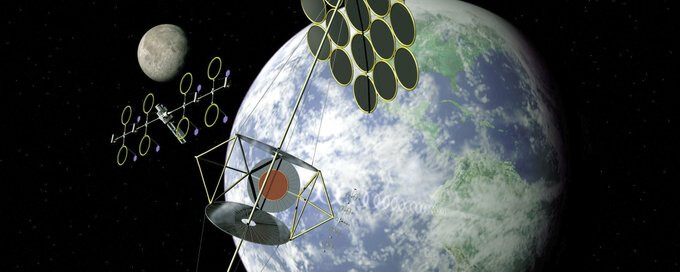
The crossover is not primarily about counting rocket launches. It is about energy (continuous solar power beamed from orbit), materials (asteroidal and lunar resources that never touch Earth’s biosphere), real estate (orbital and planetary habitats), manufacturing (zero-gravity and vacuum processes impossible on Earth), and the simple expansion of the domain of human economic activity from one planet to the solar system.
Why the Numbers Work
Launch cost is the master variable. Every order-of-magnitude reduction multiplies the feasible payload mass and therefore the rate at which orbital and planetary capital stock can be built. Starship is designed to deliver that reduction. Once flight rates reach the hundreds per year, the economics of large-scale solar power satellites, rotating habitats, and propellant production on the Moon and Mars shift from speculative to industrial. The same physics that makes space hard also makes certain activities uniquely productive there: continuous sunlight, vacuum, microgravity, and access to resources that dwarf Earth’s accessible crust.
Musk’s own framing is illuminating. He has noted that asteroid mining is not the near-term competitive path for most elements—Earth still has them cheaper—but the multiplanetary goal is not resource extraction for its own sake. It is the preservation and expansion of consciousness itself. The economic surplus is a byproduct of that civilizational insurance policy.
A Positive Horizon
The space economy of 2066 will not impoverish Earth. It will enrich it. Space-based solar power can deliver clean baseload electricity without competing for terrestrial land or weather-dependent capacity factors. Earth-observation constellations already improve agricultural yields, disaster response, and climate modeling; their descendants will be still more precise. Orbital manufacturing can produce perfect crystals, new alloys, and pharmaceuticals free of gravity-driven defects. Most importantly, a multiplanetary civilization is a civilization that can absorb shocks—asteroid impacts, supervolcanoes, or self-inflicted catastrophes—without existential risk.
The transition is already under way. Capital is flowing. Vehicles are flying. The cost curves are bending. Elon Musk’s repeated insistence that Starship makes life multiplanetary is not marketing; it is an engineering and economic claim that the data of the last decade have made steadily more credible.
Four decades from now the dominant source of new economic value will no longer be confined to the thin biosphere of a single planet. The stars will have become productive territory. Humanity will be richer, more resilient, and more expansive than any previous generation could have imagined. That is the arc. The numbers already point the way. The work of building it has begun.