
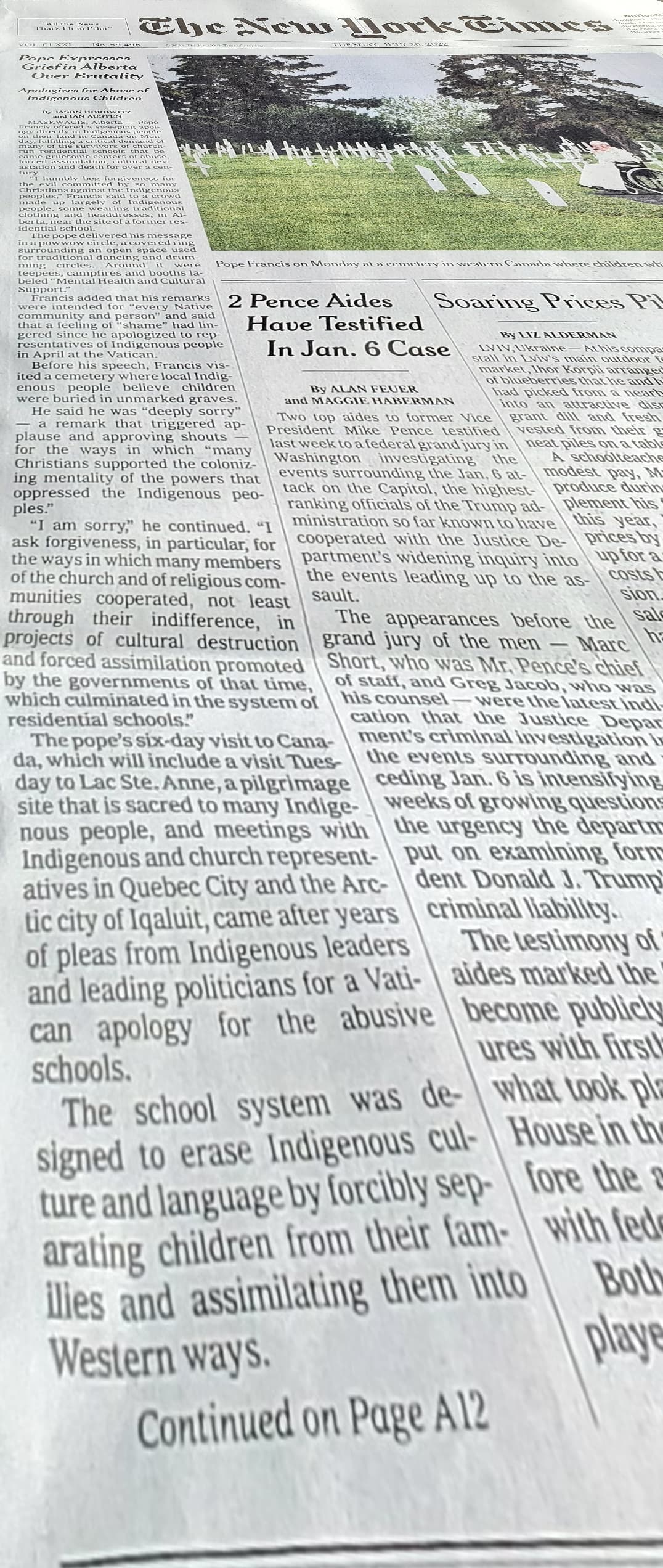
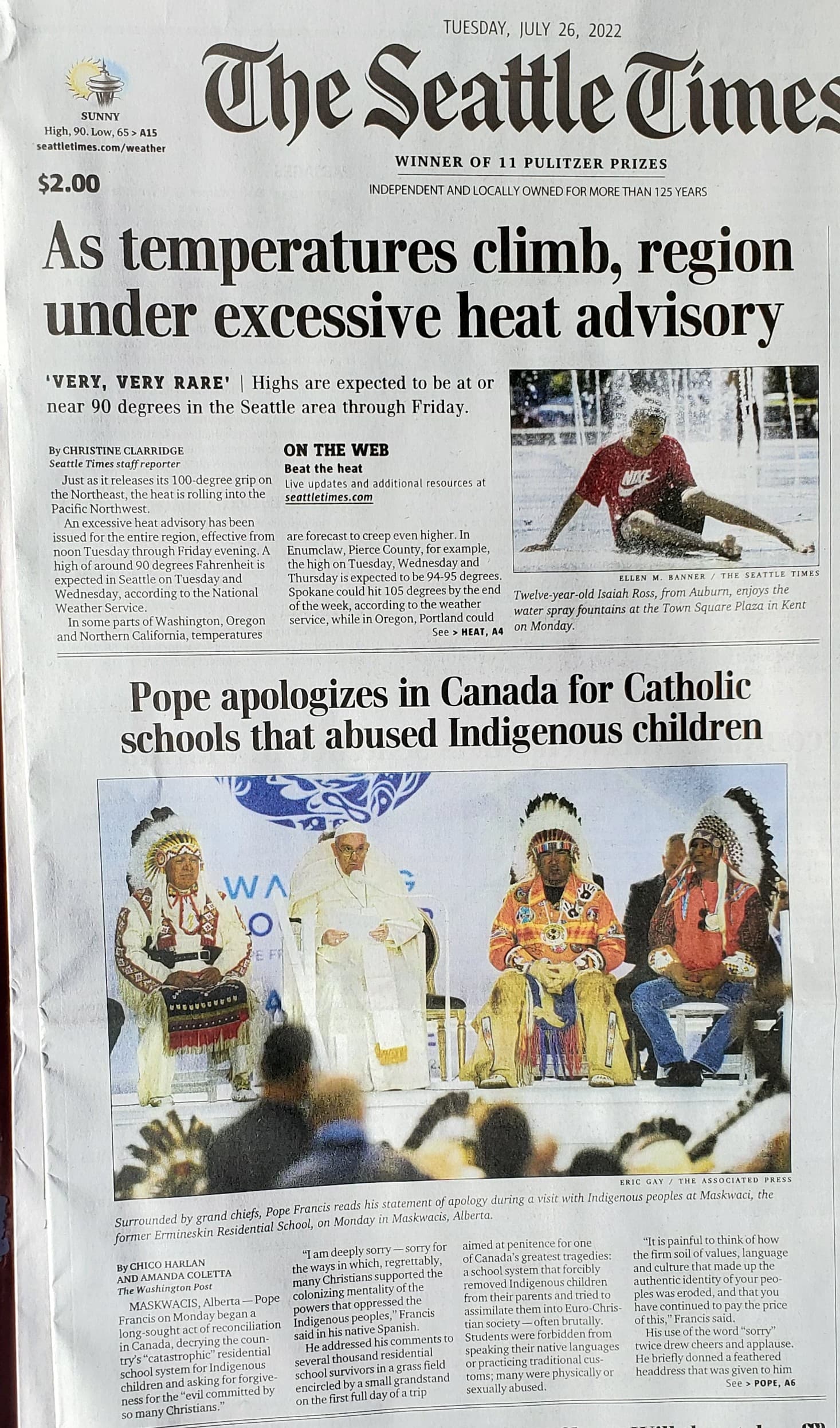
I wonder when His Holiness will be begging forgiveness for burning “heretics” at the stake or slaughtering the Cathars.
More interesting, to me personally, than the Vatican’s latest public relations stunt is seeing the front pages of these two newspapers – NYT and Seattle Times – and what the front-page stories are. To caricature (but not much), they are:
- climate change apocalypse near!
- Europeans/whites and their culture = evil
- Jan. 6 hijinks = attempted revolution
I support anyone’s right to totally disagree with me on this, but the idea that any significant portion of the U.S. population could consume this sort of propaganda on a regular basis absolutely horrifies me.
WHO ARE THE LAMANITES?
WHO ARE THE NEPHITES?
The Holy Spirit works in mysterious ways.
Repent.
PS. The physical image of the dying “newspaper” is super wicked. Thank you for sharing your headlines.
I see this as more than a public relations stunt, this is an acknowledgment of history that some would prefer be forgotten or never known. They aren’t saying that “Europeans and their culture are evil,” but recognizing other cultures as being valid and as not necessarily inherently satanic and in need of being cleansed from the earth.
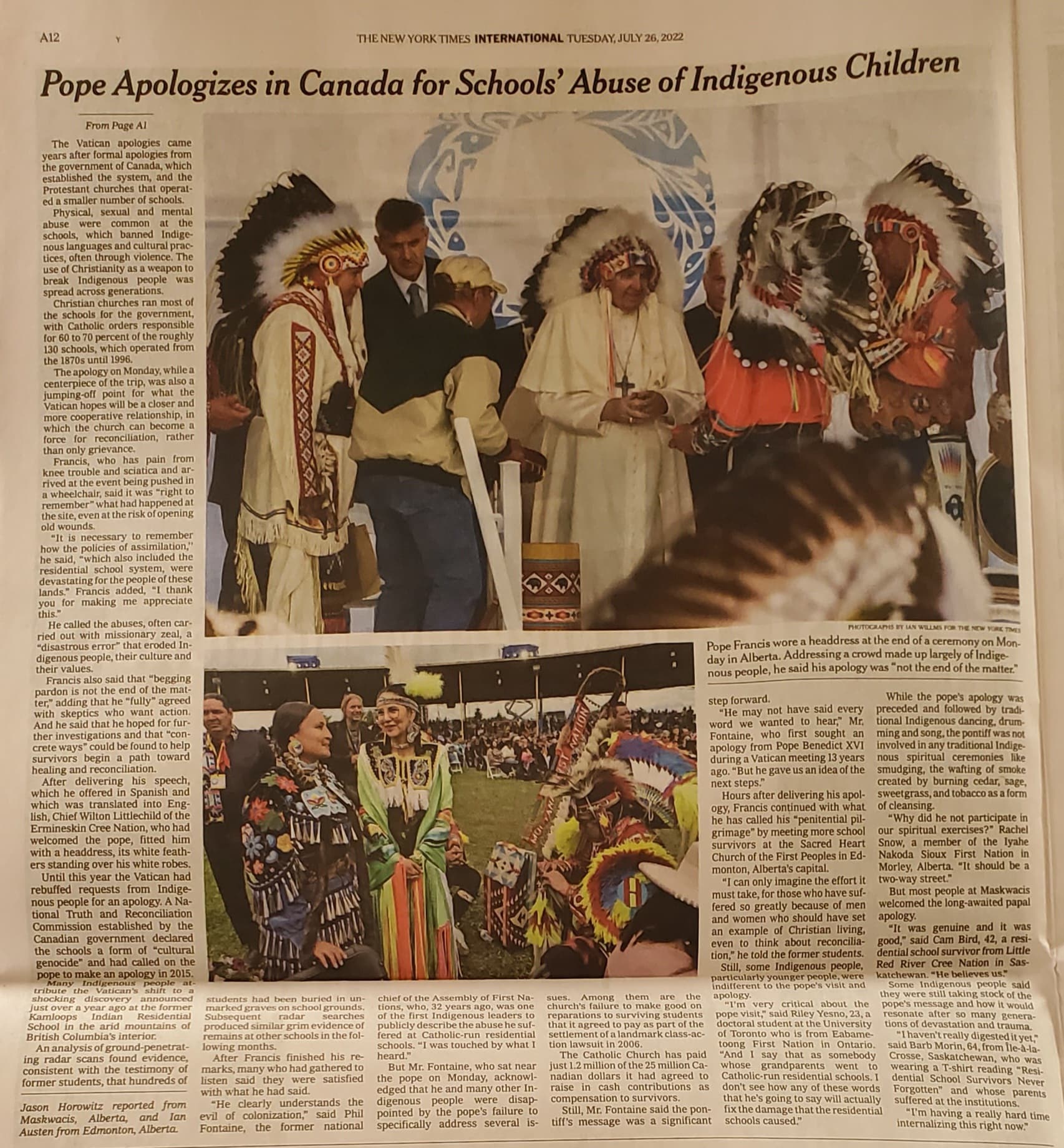
I can understand that. I just think this is the Vatican being politically correct, not sincere. I’m not sure it’s in the Vatican’s DNA to be sincere.
I do think the subtext (not of this article specifically, but of the continual apologies for past wrongs) is that European culture is inherently bad, exploitative, etc.
Yeah you may be correct about that, in this case the Pope is specifically apologizing just for the people who created these indoctrination camps not the entire church or the Vatican.
Writers do often portray the colonizers as overly bad and not necessarily give due credence to the whole history. Slavery existed already in some native tribes before the European’s ships arrived, and I’ve also heard that some of the slaves brought over from Africa to America where in fact sold by some of the African tribes willingly not taken by force by the English or Dutch.
Selling off the troublemakers and other undesirables in exchange for “stuff” was a Win win situation for the tribal leaders. I would suppose once they ran out of those types others were rounded up. Easy way to exchange people for “stuff”.
What? Is that pope apologizing for the abusers while not accepting responsibility for the church’s role in establishing the policy of converting the “savages”? Wait, he’s infallible and can’t say the church is wrong.
@Peter
Do you think this Pope understands “Repent”?
I never thought that one could devolve to this state as a Head of a Religion, but here we are!
I believe The Pope is a clone, and as such, incapable of spiritual repentance and/or baptism.
I believe the entire PR stunt is to cover over the real story of the American Aboriginal.
They cannot allow the truth to EVER come to LIGHT.
The groveling, and crow eating is to reassert the fake titles and history selected by The Evil One and his ENDOWMENT ENRICHED CHAOS CULT. (currently on deathbed). Hallelujah!
FATHER, FORGIVE US OF OUR SINS and THE SINS OF OUR FOREFATHERS.
REPENT!
I am waiting for sincere apology from British and later American Empire for their killings and land grabs of Native Americans. Ever thought why there is only 1% of Native Americans out of entire population in Canada and USA, and on average 30-50% of Native Americans in South America.
I will give you the clue, South America was colonized by countries where Roman Catholicism is predominant. Canada and USA were colonized by Perfidious Albion. You do the math who is a real killing machine in the world.
Did any pope ever begged for forgiveness from the Europeans for the horrific inquesition in Europe?
probably not would be good to start some petitions for that
(In case anyone hasn’t read this article, this is the first response to demands for an apology since 2015 from the National Truth and Reconciliation Commission established by the Canadian Government, The Vatican has ignored all requests for acknowledgment of this genocide from them until now).
I’ve not encountered the phrase until now. Thanks for posting.
Yes, they did. JPII profusely apologized for variety of atrocities throughout centuries of their reign in the West. Google it, plenty info in the net. if you at it check out statistics of RCC and compare with their Lutheran and Kalvin contemporaries, you are in for a quite a surprise.
They did. Good.
I should have checked it before posting the question… I am going o look it up.
My question is: Did the New York Times or Seattle Times run full-page stories on each of JP II’s apologies? Did JP II make a trip to the south of France for a photo opportunity, or to say a mass, when apologizing for the Albigensian crusade? It seems to me the current pope is addicted to being in the headlines, rubbing elbows with the Mr. Globaloney crowd, and making sure he doesn’t appear non-woke.
I can accept an institution apologizing for something it did in the past. I don’t, however, believe the sons are guilty for the sins of their fathers; or that one person can apologize or atone for another person’s crimes; or that anybody alive today can be held responsible for what dead people did.
The NYT printed this article on March 13th of 2000:
Pope Asks Forgiveness for Errors Of the Church Over 2,000 Years
Saying ‘‘we humbly ask forgiveness,’’ John Paul II today delivered the most sweeping papal apology ever, repenting for the errors of his church over the last 2,000 years.
‘‘We cannot not recognize the betrayal of the Gospel committed by some of our brothers, especially in the second millennium,’’ the pope, dressed in purple robes for Lent, said in his homily. ‘‘Recognizing the deviations of the past serves to reawaken our consciences to the compromises of the present.’’
The public act of repentance, solemnly woven into the liturgy of Sunday Mass inside St. Peter’s Basilica, was an unprecedented moment in the history of the Roman Catholic Church, one that the ailing 79-year-old pope pushed forward over the doubts of even many of his own cardinals and bishops. He has said repeatedly that the new evangelization he is calling for in the third millennium can take place only after what he has described as a church-wide ‘‘purification of memory.’’
To underline the apology’s religious significance, seven cardinals and bishops stood before the pope and cited some of the key Catholic lapses, past and present, including religious intolerance and injustice toward Jews, women, indigenous peoples, immigrants, the poor and the unborn.
The pope also mentioned the persecution of Catholics by other faiths. ‘‘As we ask forgiveness for our sins, we also forgive the sins committed by others against us,’’ he said.
At the beginning of his pontificate, John Paul’s boldest gestures were on the political front, confronting Communism in the Soviet Union, Eastern Europe and Latin America and also challenging human rights violations and the economic injustices of capitalism. But the apology, issued in the twilight of his papacy, is theologically more daring.
His effort to cleanse his church’s conscience for the new millennium has already drawn criticism, but it is almost certain to mark his legacy deeply.
‘‘The apology does not just apply to individuals, but the church as a whole, and that is very important,’’ the Rev. Lorenzo Albacete, who teaches theology at St. Joseph’s Seminary in Yonkers. ‘‘Because it reflects this pope’s desire to reconcile with other Christians and other religions, people are tempted to view it as a tactic, but its immense spiritual importance to this pope lies in the fact that it did not come within a diplomatic or theological agreement, but in the liturgy of the Mass during Lent and the Holy Year.’’
The pope, broadening a process of reconciliation that began in the 1960’s during the Second Vatican Council, has issued apologies before, notably regretting in a 1998 document the failure of many Catholics to help Jews during the Holocaust. That document, ‘‘We Remember: A Reflection on the Shoah,’’ disappointed many leading Jewish groups, which complained that the pope did not go far enough in apologizing for the silence of church leaders, including the wartime pope, Pius XII.
Today, in the prayer dedicated to ‘‘confession of sins against the people of Israel,’’ John Paul did not mention the church’s behavior during the Holocaust, just as he did not elaborate on other sins of the church. He said, ‘‘We are deeply saddened by the behavior of those who in the course of history have caused these children of yours to suffer, and asking your forgiveness we commit ourselves to genuine brotherhood with the people of the Covenant.’’
Rabbi Marvin Hier, dean of the Simon Wiesenthal Center, called today’s apology a ‘‘bold and important step forward,’’ but added that he was disappointed that the pope had not mentioned the Holocaust explicitly. ‘‘The church still wants to steer clear of dealing with the role of the Vatican during World War II,’’ he said.
The pope also acknowledged that church followers had ‘‘violated the rights of ethnic groups and peoples and shown contempt for their cultures and religious traditions.’’ He deplored divisions between Catholicism and other branches of Christianity, and also discrimination against women. ‘‘Given the number of sins committed in the course of 20 centuries,’’ Bishop Piero Marini, who is in charge of papal ceremonies, said before the Mass, ‘‘it must necessarily be rather summary.’’
The need for Catholics to examine their collective conscience is something that this pope has been thinking about for years, and he laid out his rationale for it in a 1994 apostolic letter called ‘‘The Coming of the Third Millennium.’’ He also raised the subject privately in meetings with key cardinals, and his proposal was sufficiently ground-breaking that they requested that the theological and historical implications first be studied in depth.
The result was a dense 31-page treatise by the International Theological Commission, which, with Vatican oversight, ground out the theological precedents and also the limits to the apology.
Written by a committee and released earlier this month, the document addresses concerns that the apology will be misunderstood or misused by those ‘‘hostile to the church.’’ It also reflects other worries of theologians, who had to grapple with such complex issues as how a church that considers itself holy can admit mistakes, and whether it is fair for today’s church to condemn acts by previous generations made in good if misguided faith.
The document explains that the church is holy, but is stained by the sins of its children, and requires ‘‘constant purification.’’ It implies but does not directly address the delicate issue of whether past church leaders also erred.
‘‘The document should have put it in bold print that ‘children of the church’ includes popes, cardinals and clergy, and not just people in the pews,’’ the Rev. Thomas Reeves, editor of the Jesuit magazine America, commented. ‘‘The pope had a great idea that some in the Vatican are obscuring with a fog machine.’’
The document also cautions against judging past generations by today’s moral or religious standards, and says today’s believers cannot be held responsible for sins committed by Catholics hundreds of years ago.
It nevertheless concedes that there is ‘‘an objective collective responsibility’’ for past errors that modern Catholics should acknowledge and repent.
At a news conference last week, Cardinal Joseph Ratzinger, who heads the Vatican’s Congregation of the Doctrine of the Faith, the modern successor to the Inquisition, addressed the issue of why the church feels ready to concede error now, and not in earlier times.
Protestantism and the Enlightenment ‘‘created a new historiography of the church, claiming that it was not just stained by sin but completely corrupt, so the church had to build up a Catholic historiography to combat it,’’ he explained. He said the collapse of atheist, totalitarian systems had left the church ‘‘in a new situation of freedom to return to our sins.’’
But the difficulty for theologians and church historians to determine what exactly constituted knowable error during the Crusades, the Inquisition, holy wars, the burning of heretics and the forced conversions of Indians and Africans, led to a more elliptical reference to ‘‘sins committed in the service of truth.’’ Cardinal Ratzinger prayed that Catholics would recognize ‘‘that even men of the church in the name of faith and morals, have sometimes used methods not in keeping with the Gospel.’’
The pope said, ‘‘Christians have at times given in to intolerance and have not been faithful to the great commandment of love, sullying in their way the face of the church.’’ But he did not note specific episodes in the church’s history like the Crusades or the Inquisition.
John Paul, who rode up the basilica aisle on a rolling platform, a strength-saving device he has been using since Christmas, read his homily in a clear, firm voice that belied the palsied trembling of his hands, a symptom of Parkinson’s disease.
The pope’s act of repentance was so unusual that some Catholics predict that it will take time for its full importance to sink in.
‘‘This is an entirely new thing,’’ said the Vatican spokesman, Joaquin Navarro-Valls. ‘‘I think it will take years for the church to absorb it.’’
A version of this article appears in print on March 13, 2000, Section A, Page 1 of the National edition with the headline: Pope Asks Forgiveness for Errors Of the Church Over 2,000 Years.
For decades I worked with people who were boarding school survivors. The level of cruelty was mind stopping. And as we know, where vulnerable and unprotected children are there also child predators collect. I hope that the present public discussion promotes healing as opposed to further pain and disarray…
I hope so too.
Here’s a three-part special report about the Tulalip schools published by the Everett Herald recently: