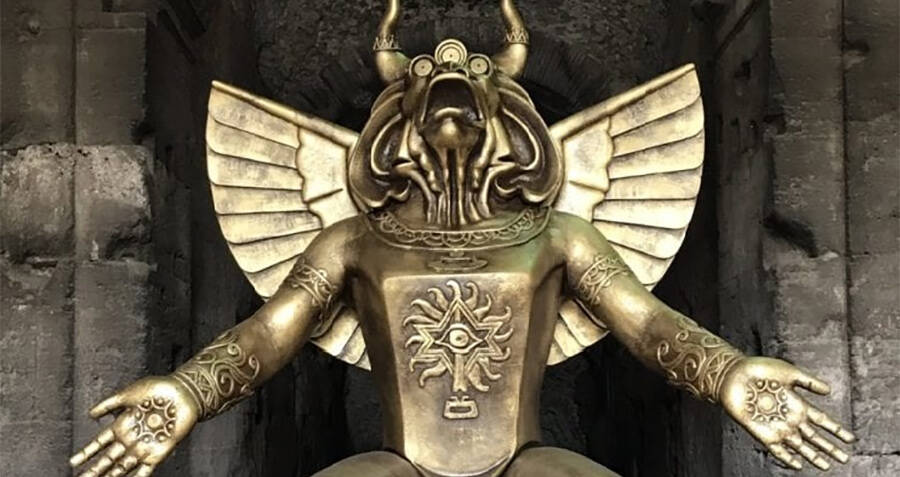
Enlil = Shemihazah, Put simply, when you see any of these names: Saturn, Kronos, Baal Hammon, El, Milcom (and its variant, Molech), Dagan, Assur, Enlil, Kumarbi, and Shemihazah, please remember that they all refer to the same entity. It’s the same god who’s used different identities as times, places, and people changed.
The Second Coming of Saturn Part 2: The Dark God in the Abyss
December 2, 2021 by Derek Gilbert
by Derek Gilbert
Let’s start with a bit of explanation about where this is going. It’s my belief that the entity known to us as the Roman god Saturn or his Greek equivalent Kronos has gone by many names over the centuries. We can trace his origins much farther in history, however, than the classical era—farther even than Greece’s Archaic period, which began around the time that Isaiah was called to prophesy in the middle of the eighth century BC.
Put simply, when you see any of these names: Saturn, Kronos, Baal Hammon, El, Milcom (and its variant, Molech), Dagan, Assur, Enlil, Kumarbi, and Shemihazah, please remember that they all refer to the same entity. It’s the same god who’s used different identities as times, places, and people changed.
I believe this entity has two other names, but I’ll withhold those for now to build dramatic tension.
The characteristics of this entity—his personality, if you will—has changed over the years, or at least has been perceived differently by various cultures. He was often seen as cunning, cruel, and vindictive, especially where humans were concerned; at other times, he was believed to be kindly, wise, and the ruler of a better time when the world was at peace and blessed with plenty.
All of his aspects, however, are linked to the netherworld. Clues embedded in the myths and rituals of the cultures that occupied the lands of the Bible lead to fascinating conclusions about the nature of this character.
Most significant, he led a rebellion against God that was remembered by Jews of the Second Temple period, the time that includes the ministries of Jesus and the apostles. This uprising, believed to be one of the reasons the world is in its fallen state, is referenced in the New Testament, most prominently by Peter and Jude. This rebellion not only violated a taboo against species propagating outside of their own kind, but Saturn and his colleagues were also condemned for teaching humanity things we weren’t supposed to know.
For this rebellion, he and his associates were banished to Tartarus. This is an important piece of information that’s not obvious to English-speakers because the Greek word tartarōsas in 2 Peter 2:4 is rendered “hell” in most English-language Bibles.
However, even though his rebellion took place before the Flood of Noah and was probably the reason for it, this fallen angel still affects our world today, and not in a good way. How is that possible? We can only speculate, but I’ll try to offer some plausible reasons.
We’ll begin with his oldest incarnation and work our way forward in time. This takes us back to the first book of the Bible, where the first four verses of the sixth chapter of Genesis describe, very briefly, an event that’s had a far-reaching impact on humanity.
When man began to multiply on the face of the land and daughters were born to them, the sons of God saw that the daughters of man were attractive. And they took as their wives any they chose. Then the Lord said, “My Spirit shall not abide in man forever, for he is flesh: his days shall be 120 years.” The Nephilim were on the earth in those days, and also afterward, when the sons of God came in to the daughters of man and they bore children to them. These were the mighty men who were of old, the men of renown. (Genesis 6:1–4)
Those four verses are among the most controversial in the Bible. The early church understood their meaning. So did the apostles. In short, the “sons of God” were supernatural beings who came to earth and mated with human women. These unions produced monstrous offspring with disastrous consequences.
This is not the majority view of Christian theologians today. Most seminaries teach that the bene ha’elohim of Genesis 6 were righteous male descendants of Seth, the third son of Adam and Eve. The Nephilim were created by their unions with the wicked female descendants of Cain. This interpretation was brought into the mainstream of Christian theology in the early fifth century AD by Augustine, the bishop of Hippo, who popularized a view put forward about a hundred years earlier by Julius Africanus.[1]
We’ve dealt with this elsewhere, especially in Veneration and Giants, Gods & Dragons, the books I coauthored with my best friend (my wife Sharon), so I won’t recapitulate the arguments here. The bottom line is that Genesis 6:1–4 means exactly what it says: Angels mated with humans. This had disastrous consequences for humanity, and it earned the angels a terrible punishment as a result.
The noncanonical Book of 1 Enoch, written between the late fourth century BC and about the time of Jesus’ birth,[2] describes this event in more detail. What’s more, it names the leader of the rebellion—the entity we identify as Saturn of the Romans.
When the sons of men had multiplied, in those days, beautiful and comely daughters were born to them. And the watchers, the sons of heaven, saw them and desired them. And they said to one another, “Come, let us choose for ourselves wives from the daughters of men, and let us beget children for ourselves.” And Shemihazah, their chief, said to them, “I fear that you will not want to do this deed, and I alone shall be guilty of a great sin.” And they all answered him and said, “Let us all swear an oath, and let us all bind one another with a curse, that none of us turn back from this counsel until we fulfill it and do this deed.” Then they all swore together and bound one another with a curse. And they were, all of them, two hundred, who descended in the days of Jared onto the peak of Mount Hermon. And they called the mountain “Hermon” because they swore and bound one another with a curse on it. And these are the names of their chiefs: Shemihazah—this one was their leader.[3]
Shemihazah, sometimes transliterated Shemyaza or Samjaza, likely means “the Name has seen” (or “My Name has seen”), a reference to Yahweh. That’s ironic, because of course God did see, and He did not approve. But we’re getting ahead of ourselves.
You may be surprised to learn that the Watchers are mentioned in the Bible—just once, in the fourth chapter of Daniel, where the Chaldean king Nebuchadnezzar relates his dream:
I saw in the visions of my head as I lay in bed, and behold, a watcher, a holy one, came down from heaven…. Let his mind be changed from a man’s, and let a beast’s mind be given to him; and let seven periods of time pass over him. The sentence is by the decree of the Watchers, the decision by the word of the holy ones, to the end that the living may know that the Most High rules the kingdom of men and gives it to whom he will and sets over it the lowliest of men. (Daniel 4:13, 16–17, emphasis added)
Since the punishment of Nebuchadnezzar, the earth’s most powerful king in his day, was decided and decreed by the Watchers, they clearly have some authority over the administration of God’s creation. Obviously, this was not the same group who rebelled in the days of Jared and Enoch, so the term “watcher” (Hebrew `iyr) appears to define a class of powerful angel, not all of whom were loyal.
That disloyalty shouldn’t surprise us. We know that the rebel in Eden, Satan, is called a “guardian cherub” in Ezekiel 28, and, like the sons of God in Genesis 6, he chose to reject God’s authority and do his own thing. So, it’s evident in the Bible that angels were created with free will, just like we humans. God did not create the entities in the spirit realm or those of us occupying the natural realm as automatons, unable to think and act for ourselves. And, just like us humans, a fair number of angels decided to go their own way with predictable consequences.
Peter specifically identifies the place of incarceration for the rebel faction as Tartarus. That bit of information is obscured by our English Bibles, most of which translate the word tartarōsas as “hell.” That’s an error. The word refers to Tartarus, not Hades.
That may seem like splitting hairs, but it’s not. To the Greeks, Tartarus was separate and distinct from Hades, the final destination for human dead, and it was believed to be as far below the earth as the earth is below the sky. Some texts even put Tartarus as far below Hades as the earth is below the sky. It was a place of impenetrable darkness reserved specially for supernatural threats to the divine order—rebellious gods.
Second Peter 2:4 is the only place in the New Testament where tartarōsas is used, which means we need to sit up and pay attention. Why did Peter choose that word instead of “Hades” or “Gehenna”? It’s clear from the multiple uses of those terms that they both refer to a place of punishment in the afterlife, usually by fire.[4] The only difference is that those being punished in Peter’s account are angels. Apparently, the place reserved for sinful humans in the afterlife—Gehenna, Hades, or hell—is not where disobedient angels are sent.
What’s even more interesting about his account is that Peter makes it clear that the sin of the angels thrust down to Tartarus was sexual. The second chapter of 2 Peter refers to Sodom and Gomorrah, “sensual conduct of the wicked,” and “the lust of defiling passion.”[5] Jude is even more direct in his brief epistle, specifically accusing the imprisoned angels of sexual immorality.[6] The only example of sexual immorality by angels in the Bible is Genesis 6:1–4.
Back to our question: Why did Peter choose the word tartarōsas? Given that he wrote under the inspiration of the Holy Spirit, the choice was deliberate and inspired. At the time he wrote, Judea had been under the influence of Greek culture and language for more than three hundred years. Peter understood what Tartarus was, how and why it was different from Hades, and who was imprisoned there.
The Jewish religious scholars who translated the Tanakh (what we Christians call the Old Testament) from Hebrew into Greek about three hundred years before the birth of Jesus understood the connection between the old gods of the pagans and the giants of Genesis 6. In the Old Testament, there are verses where the translators chose t itanes (Titans) and gigantes (giants) for the Hebrew word rephaim. As we explained in chapters 1 through 3 of our book Veneration, the Rephaim were the spirits of the Nephilim destroyed in the Flood, but the pagan cultures around ancient Israel believed they were the spirits of their deified royal ancestors—in other words, “the mighty men who were of old.”[7]
There was a clear connection between the Nephilim of the Hebrews and the demigods of Greece and Rome. As the hybrid offspring of gods and humans, heroes like Herakles and Perseus were by definition Nephilim. Even though that was understood by the Jews of Jesus’ day and the early Christian church, it wasn’t until 1999 that Estonian scholar Amar Annus made the connection for us in the modern world. Annus showed that the term used by the Greek poets Hesiod and Homer to describe the men who lived during the Golden Age when the Titan king Kronos ruled the world, meropes anthrôpoi, was derived from the same Semitic root, `rp, behind the Hebrew word Rephaim.[8] He went a step farther, showing that the name of the old gods of the Greeks, the Titans, came from an ancient Amorite tribe, the Tidanu,[9] about which we’ll have more later.
The Book of 1 Enoch expands on the account in the Bible, especially 1 Enoch chapters 6–11, part of what scholars call the Book of Watchers (chapters 1–36 of 1 Enoch). As noted above, it records that two hundred Watchers descended to the summit of Mount Hermon in the days of Jared, the great-great-grandfather of Noah, and swore a mutual oath to carry out their plan to satisfy their desire for mortal women. Hermon sits on the border between Israel, Syria, and Lebanon, and it’s the highest peak in the Levant. When the Hebrews arrived in Canaan, the native Amorites called the mountain “Sirion” or “Senir,”[10] although there is evidence that an older name for the mountain was something like “Harnam.” The Amorite Story of Aqhat, dated to the time of the judges in Israel, calls Aqhat’s father Daniel the “man of Rapiu” (the singular form of “Rephaim”), “the hero,” and the “Harnamite,” which is probably a reference to the mountain.[11] “Hermon” appears to be a deliberate twisting of the Amorite name to connect the mountain to the Hebrew word kherem, which means “ban”—as in “devoted to destruction,” a term applied to people and things declared off-limits by God.
The Book of Watchers makes the case for God’s punishment of the rebellious angels. The offspring of their forbidden unions with human women drove creation to the brink of destruction. First Enoch 7:2–5 describes three generations of monstrous descendants—first “great giants,” then Nephilim, and then Elioud, a Greek word that means “gods of glory.” Apparently, the author of Enoch understood the terms in Genesis 6—Nephilim (or “giants”), gibborim (“mighty men”), and anshei hashem (“men of renown” or, more accurately, “men of the Name”)—to refer to three successive generations of giants rather than the same group.[12]
Whether our pre-Flood ancestors contended with one generation of giants or three, the effect was the same: It was believed that the half-divine monsters nearly drove humanity to extinction. The Book of Watchers describes the giants as insatiable, devouring first the product of human labor, then humans, and then birds, beasts, and fish. When even that didn’t satisfy their hunger, they turned on each other. And if posing a threat to the existence of all life on earth wasn’t bad enough, Enoch underscores the wickedness of the giants by noting that they “drank the blood,” presumably of the creatures they consumed.[13] This was taboo. God told Noah and Moses that this was forbidden because the blood was the life,[14] a prohibition that was part of the Law given to Moses at Sinai.[15]
But the transgression of the Watchers was more than just violating a taboo against interspecies sex and burdening mankind with the threat of destruction at the hands of their monstrous offspring. The text of Enoch, which influenced Jewish thought about the rebellious Watchers down to the time of Jesus and the apostles, makes clear that the other half of their plot was the dissemination of forbidden knowledge—deadly secrets that humanity was not meant to know.