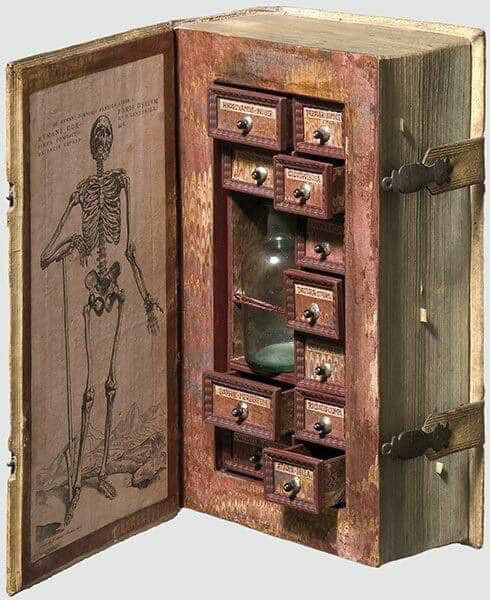
This is a secret poison case disguised as a book from the 17th century. The interior is crafted into 11 drawers, all varying in their size.
It is unkown how may victims this book claimed.

This is a secret poison case disguised as a book from the 17th century. The interior is crafted into 11 drawers, all varying in their size.
It is unkown how may victims this book claimed.
Skullduggery is an ancient art…
I love the selection. I’d pick pretty much the same ones. Mezereum and Bryonia are interesting additions (not my first choices). Notice there is no Conium (poison Hemlock) . I have no idea what Picinus - Comm is. I suspect a 'shroom?
Looks to be rat poison, derivative of castor oil.
But, but, but…
"…The U.S. Food and Drug Administration (FDA) has approved castor oil as a natural laxative for relief from temporary constipation, making it the oil’s only legitimate health-related use. Castor oil contains ricinoleic acid, which attaches to your intestines and causes muscle contractions that help you poop.
… Historically, castor oil was used as a natural way to help stimulate labor. As recently as 2018, a study of [more than 300 pregnant women]
(pubmed.ncbi.nlm.nih.gov) who took a “castor oil cocktail” (usually a few tablespoons of oil mixed with juice) found that 91% gave birth vaginally with little to no complications.
But that doesn’t mean it’s risk-free. Castor oil is known to cause an upset stomach and diarrhea, which aren’t problems you want to have when you’re giving birth. And on a more serious level, castor oil is associated with rapid contractions and decreased blood flow to the baby.
“You should never take castor oil for labor without your healthcare provider’s support and guidance,” Dr. Hopkins warns…"
Phew.
Wonder who the box/book/poisons belonged to.