
Two Suns?
This piece is the Victory Stele of Naram-Sin, one of the most significant monuments in the art and history of ancient Mesopotamia. It was carved around 2250 BCE to commemorate the military victory of King Naram-Sin—ruler of the Akkadian Empire—over the Lullubi, a mountain tribe.
The original pink sandstone monument is currently preserved and on display at the Louvre Museum in Paris. It is clear that the king was of above-average stature.
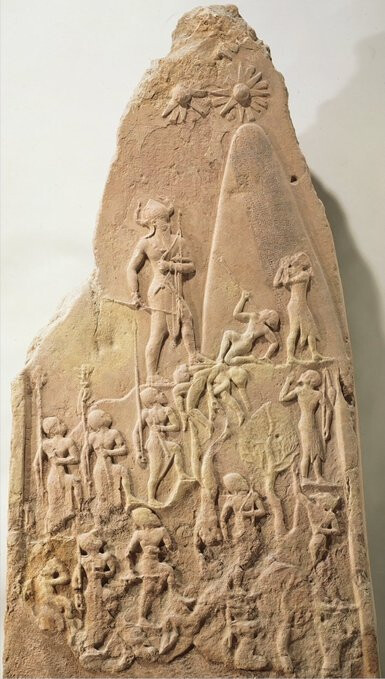
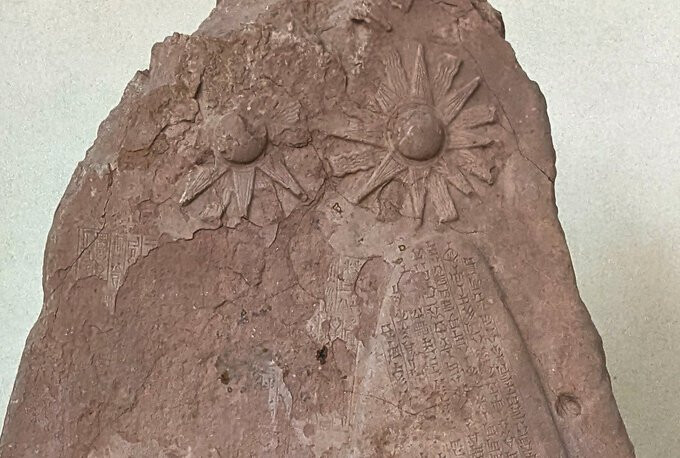
Today, I am looking closer at the Victory Stele of Naram-Sin, [below] Again we see the king stands god-sized, horned helmet [Saturn-divine only worldwide], ascending the mountain under 2 radiant celestial discs [read: there were three] while the defeated tumble below. Officially Shamash watching his victory. In my Saturn model this is pure post-flip language, the new full-spectrum Sun has taken the high ground where the old polar column once stood, and the human ruler is now elevated under it. [on the Akkadian/Tartarian] [here] Tartaria on X: "Anderson explicitly frames the Akkadians as Tartarian "Mountaineers" descended from the Armenian and Median Highlands which as their "centre of the world, the cradle of their race" . They are described as non-Semitic, with "high cheek-bones" and a culture of star-worship, cuneifor… / X Mainstream calls it Shamash. [read: Shamash = Saturn [standard] as the central, motionless sun. The sun disc with radiating rays is the symbol of Shamash [Utu in Sumerian], god of justice and light], and he is blessing his victory. [here] Tartaria on X: "Ok, I'll bite.. These are not primitive 'gods' invented by separate cultures. They are memories of the old sky configuration before the cataclysm and axis shift. This is a classic Mesopotamian [read: Babylonian/Akkadian/Tartarian] relief, most likely from a Kudurru [boundary stone… / X In the Saturn model it reads as pure post-flip language, the new full-spectrum Sun has claimed the high ground once occupied by the old polar column, and the human ruler is now elevated beneath it. [here] Tartaria on X: "Most people assume the ancient gods of the sky have always meant what we're told they mean today. But when I take a closer look at the oldest records, they reveal something strange [see previous posts], as I posit, several major deities appear to have changed meaning over time. F… / X Nergal [the ‘terrible archer’, destructive solar face in Leo, often linked to the lion] fits cleanly here as the warrior aspect of the new sky, which is the same archetype that rises when the stationary Saturn order is overthrown and the glaring Sun takes over that we see worldwide. [here] Tartaria on X: "In the standard Zoroastrian view, Ahura Mazda is the supreme creator god of light, truth. He is the eternal, uncreated high god who never fell, and he exists above the conflict, sending the prophet Zoroaster as his messenger. What you are seeing is the Faravahar disc, another post… / X Originally, there were three celestial symbols at the apex. One was damaged and removed. We don’t know what the third represented, but the surviving pair already announce the solar regime that replaced the purple dawn. Same celestial grammar we keep seeing, where we see the old polar sky gone, new solar gods on top, king now standing in their light.