
In a recent Vidchat, one participant raised a provocative question: whether Western culture took a wrong turn down the road to nihilism, and whether it deserves rescuing at all—or whether it has produced anything of genuine service to others rather than mere self-service. Dr. Farrell’s response was candid: he agreed, but cautioned that his own benchmarks along the road to nihilism may differ from anyone else’s, which is precisely why he keeps insisting the discussion must be had.
I write from a particular personal and historical background shared by millions across Hispanic America and the Iberian Peninsula—people whose walls bear the Virgin of Guadalupe, whose shelves hold statues of Don Quijote and Sancho, and who pray the rosary three times a day. I am confident that I summon these people here fairly accurately. They hold that there is no such thing as “Western Civilization”—or Civilización Occidental —and regard the term instead as an ersatz substitute, an Anglo-Masonic Protestant invention manufactured by think tanks. What we had, they say, was Christendom—a unified order that fractured after the Protestant Reformation.
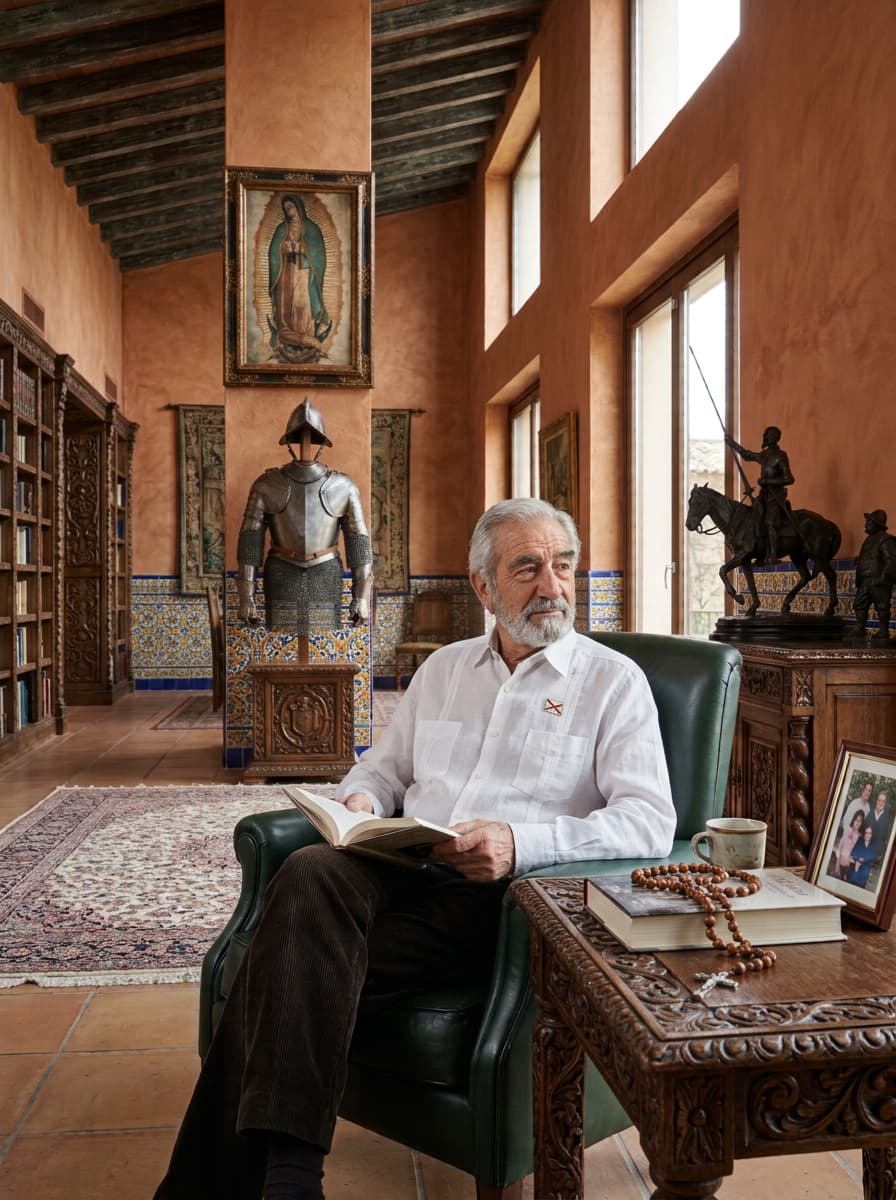
I am 99% confident that Dr. Farrell will take that analysis to the molecular level—back to Saint Augustine of Hippo, Original Sin, the Filioque, and the Ordo Theologiae . I am not dismissing that, but the question raised in the Vidchat was simply: what are other people’s benchmarks? I am answering that question, and personally I sit between the two views, because I cannot dismiss the 400 years of the Roman Catholic Monarchy and family history—a history that included the defense of San Juan against men like Sir Francis Drake and Sir John Hawkins in 1595, Sir George Clifford, Earl of Cumberland, in 1598, and Admiral Boudewijn Hendricksz of the Netherlands in 1625. For Hispanic Americans, including my own family, this was never an abstraction: we were fighting for Christendom and the protection of Catholics on these lands.
It is interesting that Samuel P. Huntington, in The Clash of Civilizations, did not include Hispanic America as part of Western civilization. In his framework, Hispanic America followed a distinct historical trajectory shaped by its exclusively Catholic heritage, its incorporation of indigenous cultures, and its corporatist and authoritarian political culture—factors that set it apart from Europe and North America, which were jointly shaped by the Reformation. Huntington states that “Latin America could be considered, a sub-civilization within Western civilization, or a separate civilization, intimately related to the West and divided as to its belonging to it” (Huntington 1996, 38–39), concluding that treating it as a separate civilization was “the most adequate and useful” for analytical purposes, precisely because Latin America “has followed a quite different development path from Europe and North America.” I disagree with Huntington, because Hispanic America did not follow anything—it was balkanized by the British through their masonic assets, who imposed the grand abstractions of the Great Architect of the Universe, gave us a bunch of Masonic Handkerchiefs for national flags, and made the region start borrowing money, when prior to that the region had provided the coin for the reserve currency of that time.
Catholic Hispanic Americans and Spaniards look at Huntington’s exclusion and nod—but for different reasons. For them, “Western Culture” is a fake substitute for what used to be called Christendom, a reality they believe broke apart with the Protestant Reformation. They do not see “Western Culture” as a neutral label; they see it as a secularized replacement that either leaves them out, as in Huntington’s map, or demands they drop their Catholic identity to fit in. Traditional Spanish thinkers have long treated “Europe” and “the West” as vehicles for a religiously neutral modernity that would dissolve Spain’s Catholic unity, while Hispanic thinkers in the hispanidad tradition make a similar point: their civilization was built on a Catholic synthesis that never went through the Reformation rupture, and the modern language of “Western values” often works to marginalize or reshape that heritage along Protestant, Masonic and secular lines. So when they call “Western Culture” an ersatz substitute, they mean something concrete—that an organic reality, whether Christendom or the Catholic Hispanic synthesis, was replaced by an abstract, secularized concept that cannot properly name what they believe themselves to be.
“Western Culture” is a label that gets applied to a bewildering range of things—Greek philosophy, Roman law, Christianity, the Enlightenment, capitalism, democracy, individualism, human rights—many of which are in tension with each other or emerged in opposition to each other. The term doesn’t name a real, unified thing; it’s a convenient sticker we slap on a bundle of historical accidents. And once you start asking “who’s in and who’s out?” (Is Russia Western? Is Hispanic America? Is Turkey?), the answer keeps shifting depending on who’s doing the labeling and for what purpose. That looks like nominalism: the word creates the illusion of a real universal, but there’s no universal there—just a name.
This is essentially what the critics I have been describing are getting at. When traditional Spaniards and Hispanic Americans call “Western Culture” an ersatz substitute, they are saying that the term does not pick out a real thing—it picks out a narrative that gets rewritten as needed. Christendom was a concrete reality with a shared faith, a shared authority, and a shared order. “Western Culture,” by contrast, is a label that can include or exclude whoever the labeler wants. That is a nominalist move in the broad sense: the name does the work, not the reality.
Did Western culture take a wrong turn toward nihilism, and what are our benchmarks for saying so? If “Western Culture” is a label that can be rewritten at will rather than a reality that can be named, then it has no fixed benchmarks at all—and a civilization without benchmarks is already well down the road to nihilism. This is why I answered the Vidchat question as I did, and why I sit between the two views: I cannot dismiss the molecular-level analysis that reaches back to Augustine and the Filioque , nor can I dismiss the 400 years of the Roman Catholic Monarchy and my own family’s history in defense of Christendom. For a traditional Hispanic, that civilization ended when the monarchy fell; what followed was not a development of Christendom but its replacement by abstractions. And for Catholic Hispanics, this is not ancient history—we are still battling the Masonic imposition today, still defending a Catholic identity against a secularized order that would dissolve it. Dr. Farrell is right that our benchmarks may differ—and that is precisely why this discussion must be had. My benchmark is concrete: Christendom was a reality with a shared faith, authority, and order, and the question of what replaced it—and what was lost in the replacement—is the question we cannot afford to leave unasked. But just as Dr. Farrell asked on the Vidchat, I want to know other people’s benchmarks.