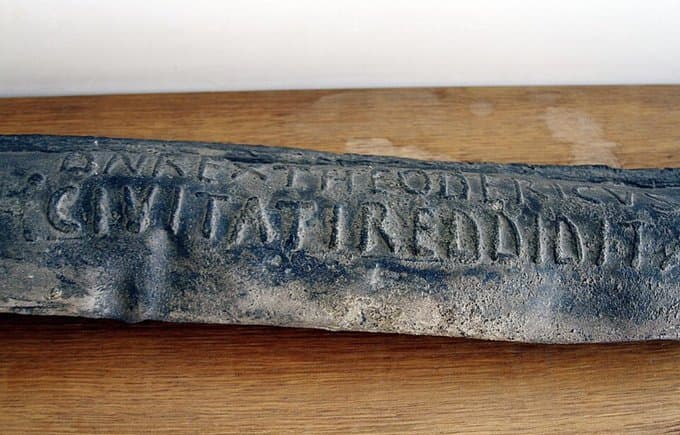
Would Rome have lasted longer if the pipes had been copper instead of lead?
No. Not in any way that matters.
The longer version is more interesting, and also less tidy. The lead-pipe theory sticks around because it turns a messy, centuries-long collapse into one almost cinematic mistake. Wrong metal. Slow poisoning. A string of mad emperors.
Its a great story. But unfortunately Its also the wrong one.
A century before Christ, Vitruvius looked at the pale, sickly men in the lead foundries and said, more or less, do not put this in the water. Use clay. He got ignored for the most boring reason in engineering. Lead was cheap, plentiful, and easy to work. Play-Doh of metals. You can roll it, solder it, stamp an owners name into it, snake it through a villa wall. Copper costs more, fights you on long runs, and does not show up as a leftover when you are mining silver for the coinage. Empires do not throw that leftover away. They turned it into pipe.
The myth also skips the lucky part. A lot of the water feeding Rome was hard water off the Apennines, heavy with calcium carbonate. That stuff plated the inside of the pipes — same crust that ruins a kettle. Once the lining built up, far less lead made it to the tap. The best public-health break the city got was accidental geology.
The aqueducts themselves were stone and concrete. Lead was mostly the last mile. Private lines into rich houses, the tanks, the street distribution. Those last miles matter. They are not the whole system.
In 2014 researchers cored mud from the Tiber and Trajan’s harbor and read the lead isotopes like a diary. Imperial tap water carried something like 40 to 100 times more lead than the local springs. Sounds awful until the next line in the paper: those levels were still unlikely to have been truly harmful at population scale. Elevated, yes. Empire-killer, no. The bones dont back it, the timing doesnt back it, and the politics dont either. Romans used lead pipe while the Republic was still expanding, while Augustus was building the so-called Golden Age, and while the West was coming apart. A poison sitting there through 500 years of rise and 200 years of fall is a weak explanation for the fall.
If some Romans were getting a real dose, it was from sapa — grape boiled down in lead or lead-lined pots until it turned into that sweet syrup they dumped into wine and food. Recreated batches of the stuff can test dozens of times over modern drinking-water limits. Cosmetics, pewter, workshop fumes did the rest. The pipes became the famous villian. The saucepan was quieter.
And copper was already in the toolbox. Valves, pumps, fittings, some pipe. Bronze too. Copper has a gift lead does not: it is naturally antimicrobial. That would have been a real upgrade in a city of baths and crowded insulae. It would not have fixed the currency, the succession fights, the shrinking tax base, the plague years, the climate swings, or an army that kept getting more expensive and less Roman.
Political violence as a habit of government. An army the provinces could not reliably pay. Lost grain lands. Demographic shocks. Enemies who had learned the playbook. Lead may have made some aristocrats duller or more gouty.
The better question is not copper or lead. It is what happens when a civilizations most impressive technology carries a hidden cost that its best engineers can see and its politics cannot act on. Vitruvius saw the pale workmen. The state kept pouring lead. Hard water quietly took the edge off. The empire rose anyway, peaked, and fell for reasons that had almost nothing to do with the metal in the wall.
That is less satisfying than a single-cause tragedy. It is also closer to how most great systems actually fail. Not one poisoned pipe. A hundred problems nobody with power was paid to fix.
Copper would have given Rome slightly better water and a nicer footnote in materials history. It would not have bought Constantine a longer map.