Lessons from a Lost Pen: How 'Simple y Confiable' Can Win Everything

Alright, let’s talk about the humble pen. You know, the thing that used to cost a quarter and worked perfectly fine for signing checks and writing “DO NOT EAT” on your lunch in the break room fridge. It’s a tube of ink with a ball on the end. It’s not rocket science. But some marketing genius in a boardroom decided that wasn’t good enough. Now, you’ve got pens that look like they were forged by elves in a titanium volcano, with a “military-grade tactical grip” for “precision control.” Buddy, you’re circling a coupon for a frozen pizza, not defusing a bomb. They’ll charge you fifty bucks for a pen that boasts it can write upside-down in a vacuum. Fantastic. The last time I checked, my kitchen counter wasn’t in outer space. It’s all just a fancy shell for the same 10-cent ink cartridge inside, but now it comes in a box with a velvet pillow so you can feel fancy while you lose it in a week.

And don’t even get me started on cars. Remember when a car was a box with wheels that got you from A to B without your knees in your chest? Now, it’s like rolling around in a spaceship designed by a tech bro with a caffeine problem. I don’t need my cup holder to tell me the temperature of my coffee or give it a Swedish massage. I just need it to hold my coffee! The dashboard used to have knobs. Beautiful, simple knobs you could turn without looking. Now it’s a fingerprint-magnet iPad that requires you to go through three sub-menus and agree to terms of service just to turn down the fan. “Enable voice command to adjust climate control?” No, I want to adjust the A/C, not have a frustrating argument with the glove box.

The real kicker? They’ve got people paying subscriptions for features that are already built into the dang car! That’s like buying a toaster and then getting a monthly bill for the “Dark Crust” setting. The hardware for the remote start is right there, sleeping in the driveway, but it won’t work unless people cough up $15 a month. It’s a brilliant, evil scheme. They’ve turned your car into a video game where you have to pay for the downloadable content to use your own brakes. So now, for the low, low price of a kidney, you can own a “smart” car that’s smarter than you, packed with junk you didn’t ask for, all to solve a problem that never existed in the first place.

And here’s the kicker—this is why an American car company that just focused on the “simple y confiable” (simple and reliable) philosophy would absolutely clean up in our markets. Forget the touchscreen that needs a software update to change the radio station. Imagine a truck—let’s call it “El Sencillo”—with a metal dashboard, actual knobs, an engine you can actually work on without a computer science degree, and zero monthly subscriptions for your heated seats. Our abuelos would approve. It would be the automotive version of a good cast-iron skillet: no fancy non-stick coatings that peel off, just something durable that works perfectly for generations and gets the job done without all the drama. People are tired of the nonsense; they just want a car that starts, doesn’t break, and doesn’t treat them like a walking wallet. The company that figures that out isn’t just selling a car, they’re selling peace of mind, and that’s a product you can’t put a price tag on.


5 Likes

What a great post! Perfect for my long boring commute to work this morning! Had me giggling and smiling to myself because I am precisely one of those people who has an apple subscription but still has to pay extra to watch movies and listen to music. I was saying to my husband that we need a record stereo system, a cd player, a dvd player, a vhs player, an old tv for the vhs (because the pixels blur on digital screens), and a bookshelf for our movies and music (they’re in storage boxes at the moment). I fell for the streaming gimmick and it costs me hundreds per month to maintain our entertainment. I like the old BIC biros. Stephen King once said that the pen is the oldest word processor.

4 Likes

A Rentier economy.
RENT!
Not OWN.
Need your BMW seat warm?
There’s a software rent feature. You can’t own it. You rent it!
It’s part of what is being termed: Enshitification.
A new book I’ve been writing about here.

Although, a new term.
it’s really taylor-made for the rentier economy…
AKA financial capitalism.

Also Taylor-made[mfr genius?] for a financiaizedl capitalist society?
Technocracy…
Of course!

3 Likes

Meet El Sencillo. This isn’t a spaceship, a subscription service, or a smartphone on wheels. It’s a return to what matters. With a metal dashboard, intuitive knobs, and an engine designed for longevity, not just launch dates, El Sencillo is built for the real world. We believe you should own every feature, every bolt, every mile—with no surprise fees. This is the peace of mind your grandfather knew, reimagined for today. Stop negotiating with your dashboard and start driving. El Sencillo. It’s a truck. El Sencillo, Built for your hands, not for your data. El Sencillo, Own it. Actually own it.

1 Like

As long as it has air conditioning because of the huntsmans.

1 Like

@Kenny: Great post. I am not alone it seems and man did you strike a nerve with ballpoint pens. First of all that Bic photo is fantastic. The subject is not only the epitome of disposable pens, the vividness, simplicity and placement of your image at the end of the post captured so well much of what you opined. Kudos. (I wonder if @justawhoaman would say it is forum message art, forum message craft or something else :wink:

For many years I worked in pharmaceutical manufacturing where one must follow “current Good Documentation Practices” (cGDPs). (Oh reader, please see what the FDA has to say on this here.) Much of my career in that industry preceded widespread use of electronic signatures so printed documents required pen-and-ink annotation and/or signature. I had long since abandoned writing for the keyboard, so my fingers were, uh, let’s say, less than obedient when making entries. Logbook error corrections were frequently made in margins and between lines, making choice of pen a bit more important than one might think. And yes, there was occasional need to correct a correction.

Not knocking the Bic at all, but my hands-down favorite pen was the Pilot; that narrow tip with fine ball and serrated grip collectively optimized legibility (ahem) of my scrawl.

Edit: I forgot to post the image; it was an investment of time to find it.
image

Per cGDP, pen ink had to be indelible; those newfangled gel pens created new issues and were quickly prohibited. Go to Walmart today and Bic is about all one will find in the ballpoint ink category (maybe 2% of shelf space). At least this long rant had benefit as I found online sources for the Pilot. Yay.

And finally, to your point @Kenny, I found this:

2 Likes

I, too, enjoyed your post, Kenny. An analogue world seems much more organic.

The other day, our heat pump broke down, and the technician thought it had something to do with the digital electric panel. I asked whether we could get a heat pump with an analogue system (i.e., manual temperature dial and on/off knob), and he said, no, all heat pumps are digital. Moreover, he said those things don’t last either, not like the analogue systems did in the past.

And so, I relate to your sentiments about pens and also all the unnecessary, unwanted gumph in cars. (We’re even wondering: when it comes time for another car in the future, will we try to find an old, used, analogue car, and a mechanic who can fix those kinds of cars! Provided that replacement parts are still to be found…)

Recently, I also read a post by a lady who prizes her “Dumb Home” and her thoughts seemed to mirror yours: Satiety Cove: My Precious “Dumb” Home - by Patricia Burke

2 Likes

Intuitive knobs (or controls). Amen, amen.

One of the very best cars I owned was an '09 Toyota Corolla. I didn’t realize how great it was until I didn’t own it anymore. The successor was a decent car, but climate control scheme was lacking in comparison.

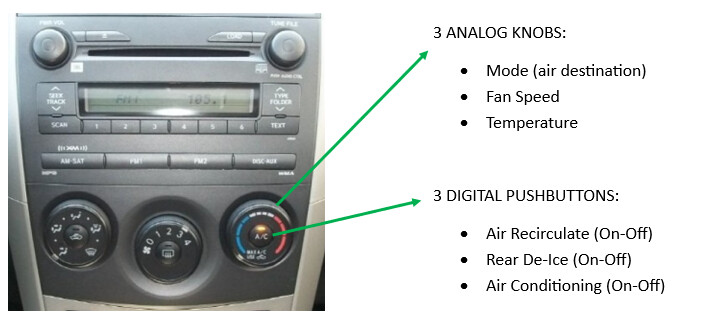
The Corolla had three knobs and three pushbuttons in a cluster within arm’s reach. I did not have to direct my attention to them to effect change; it could all be done by feel. Behind a stinky truck? Bang, press the Recirc button. Spouse’s feet a bit cold? Rotate the Air Destination knob from Vent to Vent-Floor mix. Ta-dah!

Not so with the new car. This is the Mode control. An LED Icon with Up-Down buttons to cycle thru the same five modes operation. It almost could have worked by touch: push DOWN button four or more times while driving to get reach Vent mode or UP button twice to go from Floor to Defrost because the windows are fogging. It could have worked. Nope. The Mode button sequence on this car was circular: pressing UP or DOWN five times or more takes you back around, so what does one do when the windows are fogging and traffic is congested? At some point eyes will have to guide the frantic fingers until Defrost is set. And half of that time is spent spotting the icon down there by the shift lever. Stupid.
image

In the old days, this eventually would have been standardized, much like turn signal levers, PRNDL, mirror locations, etc. Not so now. Let’s make things aesthetic, illogical and unrepairable.

Aside from having muscle cars in my youth, four of the best cars I’ve owned were Toyotas in the 2003-2010 era. Two Corollas, one Sienna and a Highlander. Here in Central America, any Toyota from the US with less than 200,000 miles is gold. I’m talking cars from the US with minor damage that were written off by insurance companies (given Salvage titles) end up down here. It is a good way anywhere actually to get a good car (or a bad car made good) for cheap. These guys get the cars at auctions, put new tires, brakes, battery, headlights, taillights and get the body work repaired and make a few thousand. Parts are still available.

Just a thought.

2 Likes

I get it. I wouldn’t trade my 2005 LandRover 3 for anything else (of course it has already had a few chew marks on the hood from my horses). It does have a few quirks, it is a Brit after all, but it navigates the ruts and dips in the drive to my house that few others could travel. I have repaired MANY failed items myself thanks to YouTube DIYers.

2 Likes

Got into a taxi in Las Vegas last year.
The driver spoke broken english, he was from some small country close to Somalia.
He asked where I was going? [It was outside a designated area].
He called HQ, to find out how to override the program.
BUT, he also neede a new platform for that area of Las Vegas.
Another “Smart” phone call.
Lots of different dialects, and back & forths.
This sub-program; push this link on your smartphone;
then push this button on, the brand-spanking new taxi.
On and on this goes…
“Why don’t I just pay you to drop this ACT now; so we can going?”
“Oh NO! It’s not an ACT!”

Anyway, everybody’s scaming everbody; and nobody, getting nowhere FAST!

3 Likes

The 90’s (mid 90’s specifically) Toyota Corolla, while perhaps harder to find now, were near the peak of that model in my humble opinion… Fuel injected but with the least amount of electronics, components were intentionally overbuilt, and the wiring harnesses still had enough pure copper in them to ward off the ground faults and voltage drop issues that cars tend to get when pushed beyond their service life. Engineers have since been steadily forced to reduce the meantime between failures to just after the warranty expires…

These cars were simple and bulletproof. One of the best things about the “slant 4” in these cars was that they were “non-interference” engines… If the timing belt happened to slip or break then you could simply install a new one (not as hard as it sounds) and continue on your way. Most of the time when this happens, as I’m sure you’re aware, the resulting catastrophic engine damage makes a repair too cost prohibitive. I bought many of these cars to repair when people gave up on them back in the day.

Sure do miss the old Toyota’s, mechanical thermostats in my appliances, all things analog, and things of true quality in general…including the ball point pens.

As it turns out… All the tea in China wasn’t really something for which we should have traded our yesterdays. Who could have guessed…

3 Likes

My first car, a used Ford LTD cop car, felt like a battle partner; I knew every inch of it. My second car was a different story—a new 1997 Suzuki Sidekick that I’ve owned since day one. It’s been unbelievably reliable, with not a single engine issue beyond basic maintenance.

3 Likes

Perhaps we are saying the same thing, but I see the issue more as “computerized-vs-noncomputerized” than “analog-vs-digital.” It was when programmable integrated circuits (IC’s) replaced discreet components (circuit boards with simple IC’s are OK) that cars and appliances stopped evolving upwards in terms of reliability, durability and repairability.

IC’s control things in both an analog manner (temperature, pressure, level, CO2, speed, mixture, etc.) and digital manner (brake on, door switch open, light off, etc.).

Machine decision-making is now performed by increasingly complex computer IC’s (as compared to simple discreet ones) and as such, more functions get buried inside the firmware and/or software.

Why do we need a “load sensing” function on the washer?? Once I put in the clothes, I just want it to fill with water, agitate, drain, spin, rinse, spin, stop (in less than one day), and most importantly, unlock the damn lid immediately after basket speed drops below 61.438 rpm. Oops, sorry. Very most importantly-- without beepers or sound effects.

Here in Central America, Speed Queen industrial washing machines are prized possessions and very expensive (US $1,000). They are the Bic ballpoint of washing machines. I’ve had one apart and they differ little from my parents’ Speed Queen purchased in '66 or '67. Mechanical timer, three controls, top load, lid switch without lid-lock and very reliable. People here have become wary of contemporary washers with membrane switches and LEDs because they take forever to wash the clothes and fail so, so quickly. I recently visited two local appliance junkyards and was not-so-surprised by the number of modern and shiny units laying around.

Programmable IC’s are not the sole cause of the problem, but their “black box” nature sure facilitates possibility of embedded stacked functions.

These guys have some great videos and talk a lot about planned obsolescence.

how-2-repair.com - YouTube

Uncle Tony’s Garage - YouTube

5 Likes

Thanks!
My brother is a fix-it kind of guy.
So I emailed him these.

All part of moving into:
A Rentier Economy; submerged into a Technocracy, w/Chinese Characteristics.

Thanks for the links!

2 Likes

Had a 1.8litre diesel Corolla (late 80s model) a battle tank and great mpg. Put over 300K miles on it before selling. A double decker bus decided to T bone it. Bus couldn’t move off, but we drove the Corolla home after exchanging documents. If I’d had a 100% discretion in the matter I would have gone for a Toyota Hilux. https://www.youtube.com/watch?v=xnWKz7Cthkk Immortal.

2 Likes

As the standard of living continues plummet in Canada, I think we will see a return to the kind of practices you are seeing in Central America. Several years ago, I was talking to someone who was reminiscing how as a child he would accompany his father to the landfill in the early 60’s and they would search for useable discarded auto parts. There is still the option of going to wreckers but the landfill is now totally off limits to the public.
We previously had a Volkswagen Fox which lasted for 26 years. My wife did not want to give it up but ultimately after much searching we could not find a replacement part and took it to the wrecker. We are now driving a 6-year-old Subaru purchased just before the aggressive implementation of electronic devices. It is a nice car to drive especially in winter.
We recently drove a 2025 Subaru courtesy car which had the full suite of electrical doodads. It was overwhelming and over the top. We were telling a young salesperson we would never buy one of those cars and he couldn’t relate to us at all.
Over the last while I have been spending some time trying to understand what life was like for people living in the GDR side of Berlin. One topic that comes up is cars. The state manufactured car the Trabant was the only car available to the Plebs. Customers had to take whatever color was available off the assembly line with waits of up to 15 years. The documentary link below covers the history and a resurgence in interest in the Traubant

2 Likes

I lost my 69 GTO with a 389 engine, 4 on the floor[always a fifth under the seat].
I got it for $300,00, it had supposedly been totaled.
Had a Mexican bring it back to life, and body primar.
Just had to steal it back from him.
Didn’t loose it in any of the above destructive methods.
Lost it; do to: “GOOD INTENTIONS”

So yea, me & Good Intentions; have a sorry, mechanical history!
She was the Best!
[besides, women of couse.
Nothing beats a good woman!
Nothing, even comes close!]

2 Likes

… Exactly! That is why I keep saying that we need to figure out a GDS scam (or get elected to congress) of some kind so that we can get in on the gravy train.

1 Like

I have a family member who recently went through military training. During a crucial exercise, his man-portable air-defense system, a piece of gear that’s supposed to be his lifeline, literally fell apart in his hands. The housing cracked, a component came loose—it just failed. He told me that in that moment, staring at the broken pieces, he knew he was a dead man. No simulation, no do-overs. That feeling of cold, gut-wrenching vulnerability when the tool you depend on betrays you—that’s the human cost of a procurement system gone mad.

This isn’t an isolated incident; it’s a symptom of a disease that infects our entire defense philosophy. We are building trillion-dollar paperweights, not weapons for warfighters. Look at the crown jewels, like the F-35 fighter jet. It’s a technological marvel, a machine that can supposedly see God and shoot a laser from the moon. But it’s so overstuffed with bespoke, bleeding-edge tech that it needs a team of wizards and a small fortune in maintenance for every hour it spends in the air. It’s the ultimate “tactical pen”—a gold-plated solution to a problem nobody really has, capable of writing upside-down in a vacuum while the grunt on the ground just needs a rifle that doesn’t jam when it gets a little dusty.

We’ve become so obsessed with achieving unassailable technological supremacy that we’ve forgotten the fundamental truths of combat: simplicity, reliability, and volume. We’re preparing for a science fiction movie, while a potential enemy is preparing for a brutal, industrial-scale war of attrition. Our gear is a fragile, high-maintenance Ferrari. We need El Sencillo philosophy—lots of them, tough, simple, and ready for a fight. Because when that training exercise becomes reality, you don’t need a miracle. You just need your gear to work.

China, Russia, Iran, Korea, those countries are prepared for large scale industrial war and we are not. We keep producing overengineered junk. This is the heart of the rot: we’ve completely forgotten what industrial warfare looks like. We’re not preparing for a fight; we’re preparing for a tech demo. A real war isn’t won by a handful of billion-dollar wizard ships. It’s won by sheer, brutal volume—by having more trucks, more drones, more ships, more artillery shells than the other guy.